Applicants
The Declining Approval Rate Crisis
EB-1A and EB2-NIW I-140 Petitions Analysis
Executive Summary
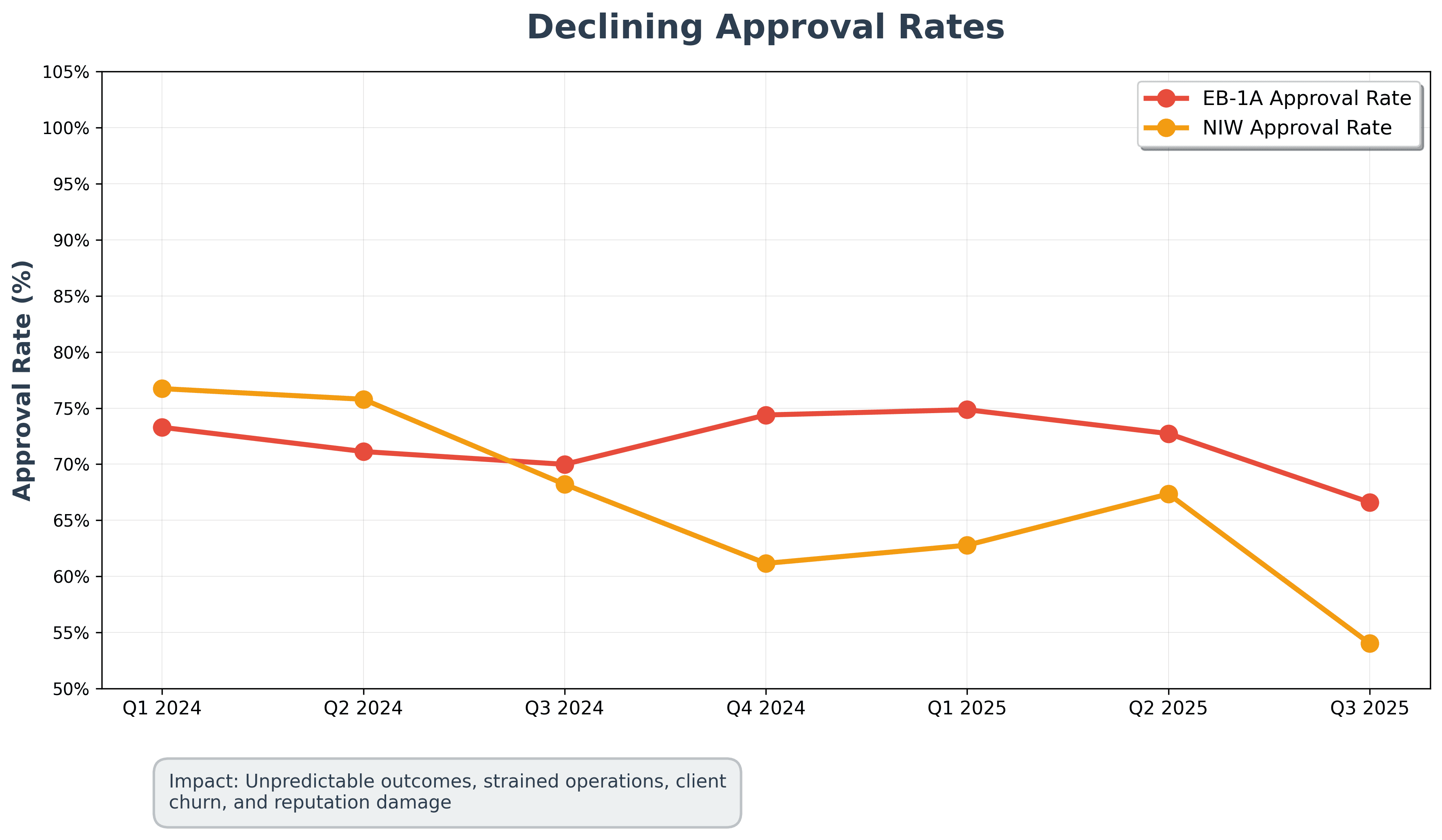
USCIS I-140 approval rates for employment-based immigration petitions have experienced significant declines from Q1 2024 through Q3 2025. This analysis reveals troubling trends that directly impact highly skilled professionals, employers, and the broader U.S. innovation ecosystem.
Key Findings
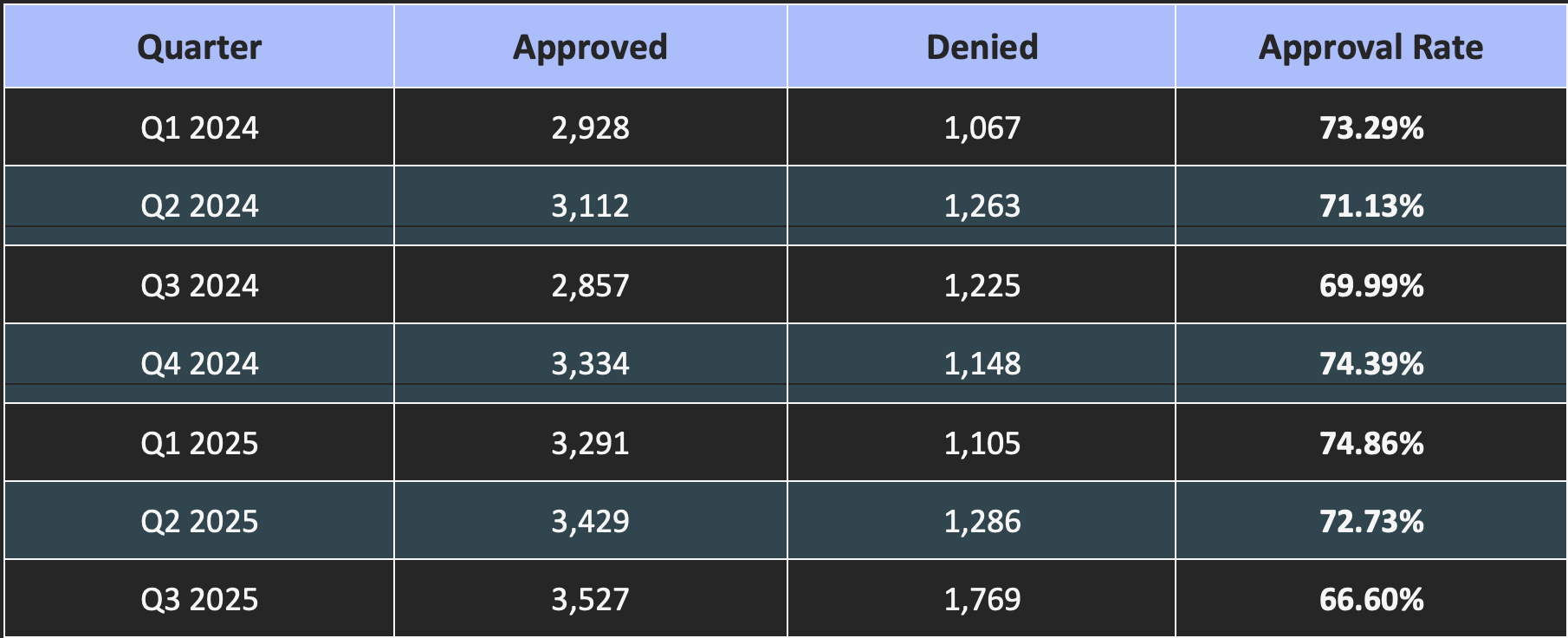
• EB-1A approval rates declined from 73.29% (Q1 2024) to 66.60% (Q3 2025), a drop of 6.69 percentage points
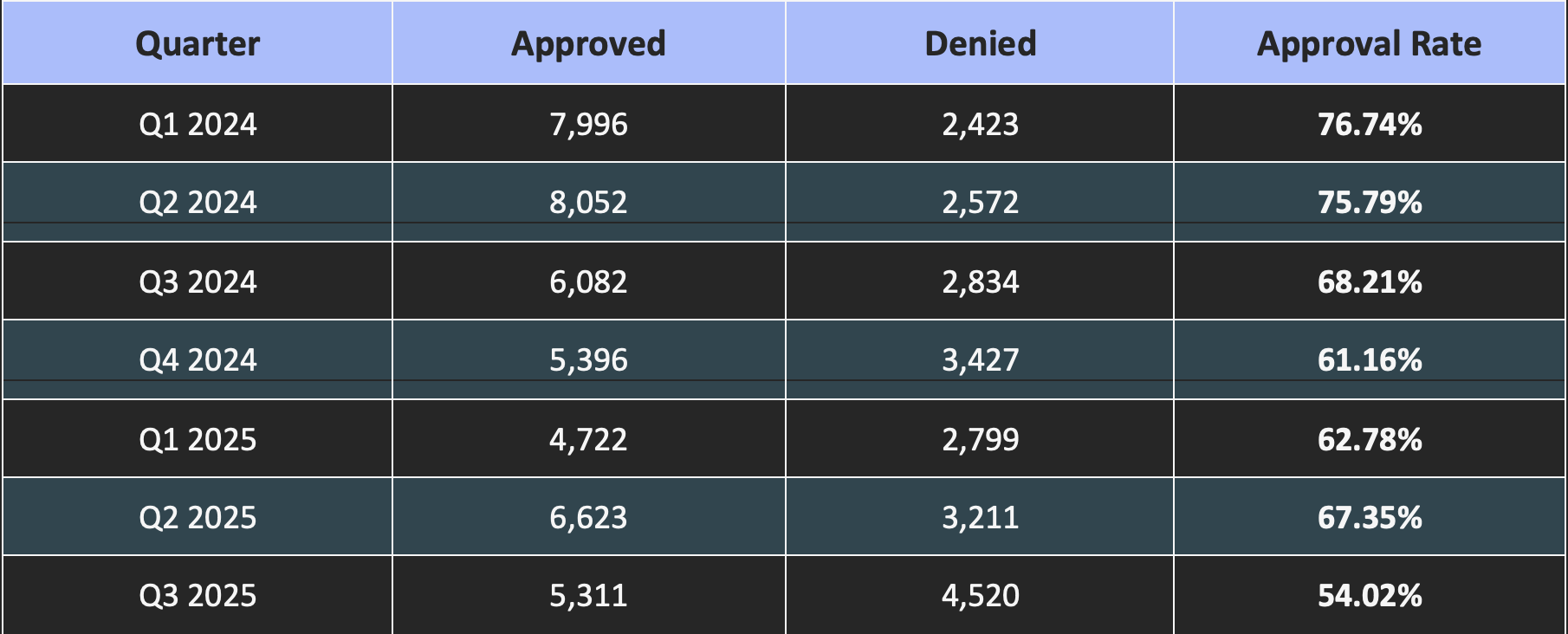
• EB2-NIW approval rates plummeted from 76.74% (Q1 2024) to 54.02% (Q3 2025), a catastrophic decline of 22.72 percentage points
• Q3 2025 saw the steepest quarterly decline: EB-1A dropped 6.13% and NIW dropped 13.33%
• NIW petitions are now approved at barely above 50%, creating unprecedented uncertainty for applicants
Approval Rate Trends
EB-1A: Alien of Extraordinary Ability
EB-1A petitions target individuals with extraordinary ability in sciences, arts, education, business, or athletics. While approval rates have remained relatively stable compared to NIW, the category still shows concerning erosion:
EB2-NIW: National Interest Waiver
The EB2-NIW category has experienced the most dramatic decline, with approval rates falling below 55% by Q3 2025. This represents a fundamental shift in adjudication standards that creates severe uncertainty for applicants:
Impact Analysis
The declining approval rates create cascading negative effects across multiple stakeholders and the broader U.S. economy:
1. Unpredictable Outcomes
With NIW approval rates below 55% and EB-1A rates at 66.60%, applicants face coin-flip odds despite investing thousands of dollars and months of preparation. This uncertainty disrupts career planning and family stability.
2. Strained Operations
Immigration attorneys must invest significantly more time in petition preparation and RFE responses, reducing efficiency and increasing costs. The higher denial rates force attorneys to manage difficult client conversations and reputation concerns.
3. Client Churn
Denied petitions lead to dissatisfied clients, negative reviews, and lost referrals. Even when denials result from USCIS inconsistency rather than attorney performance, firms bear the reputational cost.
4. Reputation Damage
As approval rates decline, immigration law firms face increased scrutiny from potential clients who may question their competence. Marketing becomes more challenging when success rates are objectively lower across the industry.
Root Causes
Multiple factors contribute to the declining approval rates:
1. Heightened Scrutiny Standards: USCIS adjudicators appear to be applying more stringent criteria for evidence evaluation, particularly for establishing ‘sustained national or international acclaim’ (EB-1A) and ‘national interest’ (NIW).
2. Increased RFE Rates: Higher volumes of Requests for Evidence signal that initial petitions increasingly fail to satisfy adjudicator expectations, often due to subjective interpretation rather than objective deficiencies.
3. Policy Drift Without Formal Changes: Approval standards appear to tighten without corresponding policy manual updates, creating an unpredictable adjudication environment.
4. Adjudicator Inconsistency: Similar petitions receive divergent outcomes depending on the assigned officer, indicating lack of standardized evaluation frameworks.
The Solution: AI-Powered Merit Evaluation Intelligent Workspace
The declining approval rates and increasing unpredictability create an urgent need for data-driven, interpretable petition evaluation tools. Meritocrat addresses this crisis using three principles i.e Collaboration i.e. Human and AI, Framework (CASE Methodology™) and Principles i.e. AI Trustworthy
Meritocrat’s AI-powered platform delivers exactly this capability, combining advanced machine learning with deep knowledge of USCIS policy to help attorneys navigate the declining approval rate landscape. By providing clear, interpretable evaluation frameworks and actionable recommendations, Meritocrat empowers attorneys to improve outcomes, reduce RFE rates, and restore client confidence in an increasingly challenging immigration environment.
The precipitous decline in I-140 approval rates represents a systemic crisis in employment-based immigration. With NIW approval rates plummeting 22.72 percentage points and EB-1A rates declining 6.69 points over just seven quarters, attorneys and applicants face unprecedented uncertainty.
Traditional petition preparation methods cannot adequately address this environment of heightened scrutiny and inconsistent adjudication. Immigration attorneys require sophisticated, data-driven tools that provide interpretable petition strength assessment, comprehensive evidence mapping, and strategic gap analysis.
Appendix: Data Summary
Cumulative Statistics (Q1 2024 - Q3 2025)
EB-1A:
• Total Petitions Received: 40,370
• Total Approved: 22,445
• Total Denied: 9,255
EB2-NIW:
• Total Petitions Received: 115,350
• Total Approved: 48,862
• Total Denied: 22,156
This article is general information, not legal advice. Meritocrat is a preparation tool, not a law firm, and does not replace qualified legal counsel.
Prepare your case in one connected workspace
Case Studio helps EB-1A, EB-2 NIW, and O-1 applicants organize evidence and review what supports each claim.