Applicants
Dates for Filing vs. Final Action Dates: How USCIS Decides When You Can File Your Green Card Application
USCIS's 2015 announcement created the two-chart Visa Bulletin system that still decides when you can file Form I-485. What each chart means, how USCIS picks one each month, and what to check before you file.
Every month, thousands of people waiting for an employment-based or family-based green card open the Visa Bulletin and ask the same question: can I file now?
The answer depends on a rule USCIS introduced in September 2015. It created the two-chart system that the Visa Bulletin still uses today. If you are waiting to file Form I-485, understanding this rule is the difference between filing on time and filing too early.
What USCIS announced in 2015
On September 9, 2015, USCIS announced revised procedures for deciding when applicants waiting to file for adjustment of status could submit their applications. The change was part of the executive actions on immigration announced in November 2014, and it aligned USCIS with the process the Department of State already used for applicants processing through consulates abroad.
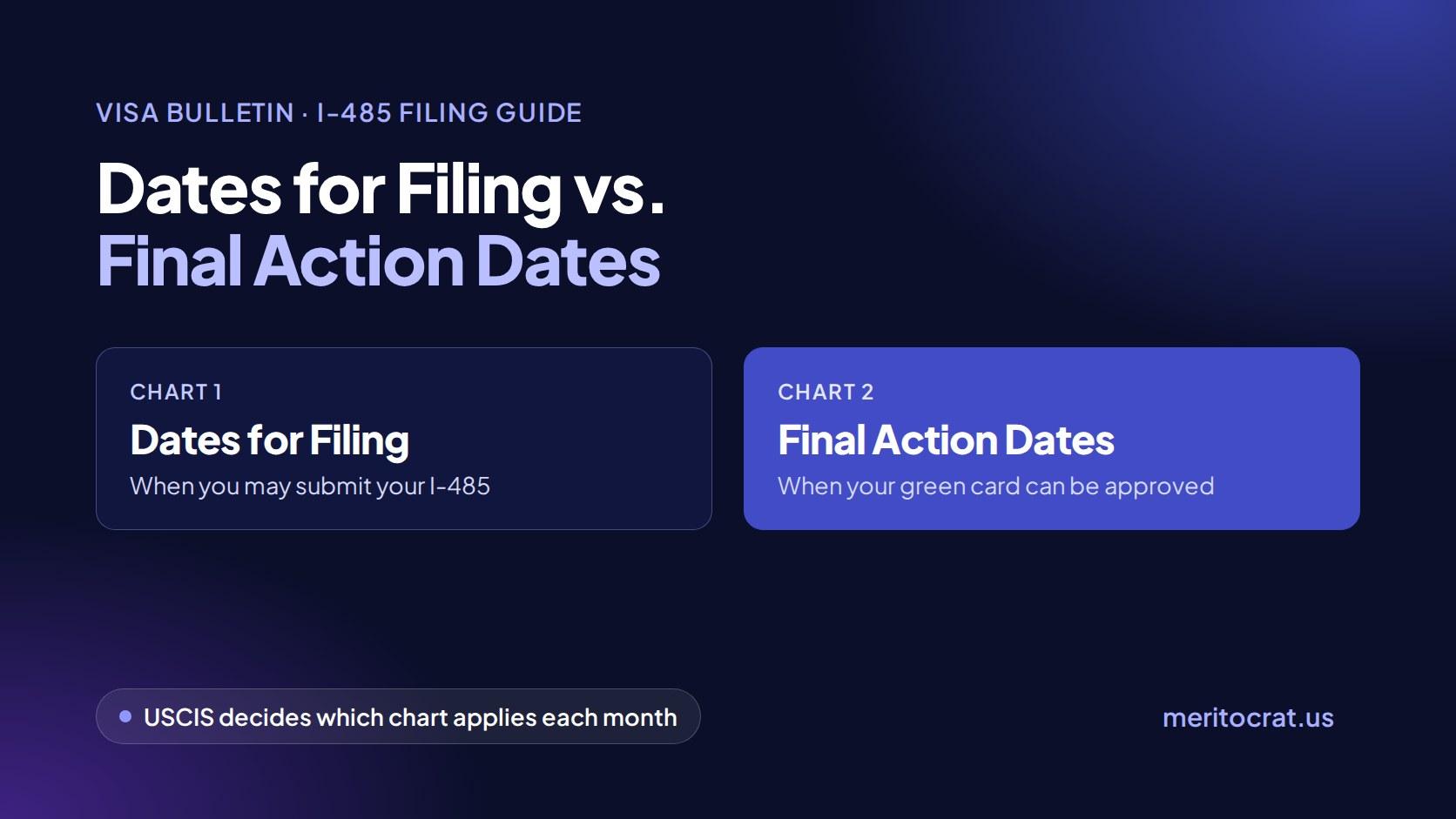
Starting with the October 2015 Visa Bulletin, the Department of State began publishing two charts for each family-sponsored and employment-based preference category:
- Application Final Action Dates: the dates when visas may finally be issued.
- Dates for Filing Applications: the earliest dates when applicants may be able to apply.
USCIS explained that it would work with the Department of State each month to compare the visas still available in the fiscal year with the number of people expected to need them. That includes:
- applicants the Department of State reports as documentarily qualified,
- adjustment-of-status applications already pending with USCIS, and
- historical rates of denials, withdrawals, and abandoned applications.
When that comparison shows more visas available than known applicants, USCIS can allow applicants to file using the Dates for Filing chart.
You can read the original announcement on the USCIS archive.
Final Action Dates vs. Dates for Filing
| Chart | What it tells you | What it means for you |
|---|---|---|
| Final Action Dates | When a green card can actually be approved | If your priority date is earlier than this date, USCIS can approve your case, assuming everything else is in order. |
| Dates for Filing | The earliest date you may be able to submit your application | If USCIS has selected this chart for the month and your priority date is earlier than this date, you may file your I-485 even though your case cannot be approved yet. |
The Dates for Filing chart is usually ahead of the Final Action Dates chart. That gap is the whole point: it lets people get their application into the system earlier, so they are ready when their date becomes current for approval.
The rule most people miss: USCIS chooses the chart
The Department of State publishes both charts, but USCIS decides which one adjustment-of-status applicants in the United States must use each month. It posts that decision on its Adjustment of Status Filing Charts page, usually shortly after the Visa Bulletin is released.
That means a date that looks current on the Dates for Filing chart is not usable unless USCIS has selected that chart for your category that month. USCIS can choose different charts for family-sponsored and employment-based categories.
Before filing, check two things:
- The Visa Bulletin for your category and country of chargeability.
- The USCIS filing charts page for which chart applies that month.
What happened in the first month
The new system had a rocky start. After the original October 2015 bulletin was published, the Department of State released a revised version on September 25, 2015 that moved several Dates for Filing back. Many applicants who had prepared to file based on the original dates could no longer do so. A lawsuit challenging the revision was later dismissed in May 2016.
The lesson still applies: dates can change, and preparation should not depend on a single month's numbers.
Why filing early matters
When you file Form I-485, you can generally also apply for a work permit (Form I-765) and travel permission (advance parole, Form I-131) while your case is pending. For many people on temporary visas, that flexibility is the main reason to file as soon as the rules allow.
It also means your adjustment package, including forms, supporting documents, and the medical exam, needs to be ready the month the window opens.
How this connects to EB-1A and EB-2 NIW
The two-chart rule decides when you can file. It does not decide whether your petition is strong enough. For self-petitioners in EB-1A and EB-2 National Interest Waiver cases, the I-140 petition and its evidence come first.
If you are waiting on the Visa Bulletin, that time is useful. You can check which criteria your documents support, see what evidence is still missing, and organize your case in Case Studio before you spend on legal counsel. For this month's outlook for India, read our October 2026 Visa Bulletin prediction.
Sources
- USCIS: Revised procedures for determining visa availability (archive)
- USCIS: Adjustment of Status Filing Charts from the Visa Bulletin
- Department of State: Visa Bulletin
- AILA: Resources on the October 2015 Visa Bulletin
This article is general information, not legal advice. Meritocrat does not determine visa availability or replace legal counsel. Always confirm the current Visa Bulletin and the USCIS chart selection before filing.
Prepare your case in one connected workspace
Case Studio helps EB-1A, EB-2 NIW, and O-1 applicants organize evidence and review what supports each claim.