Applicants
The Immigration System Already Runs on Context. Most of It Is Just Hidden.
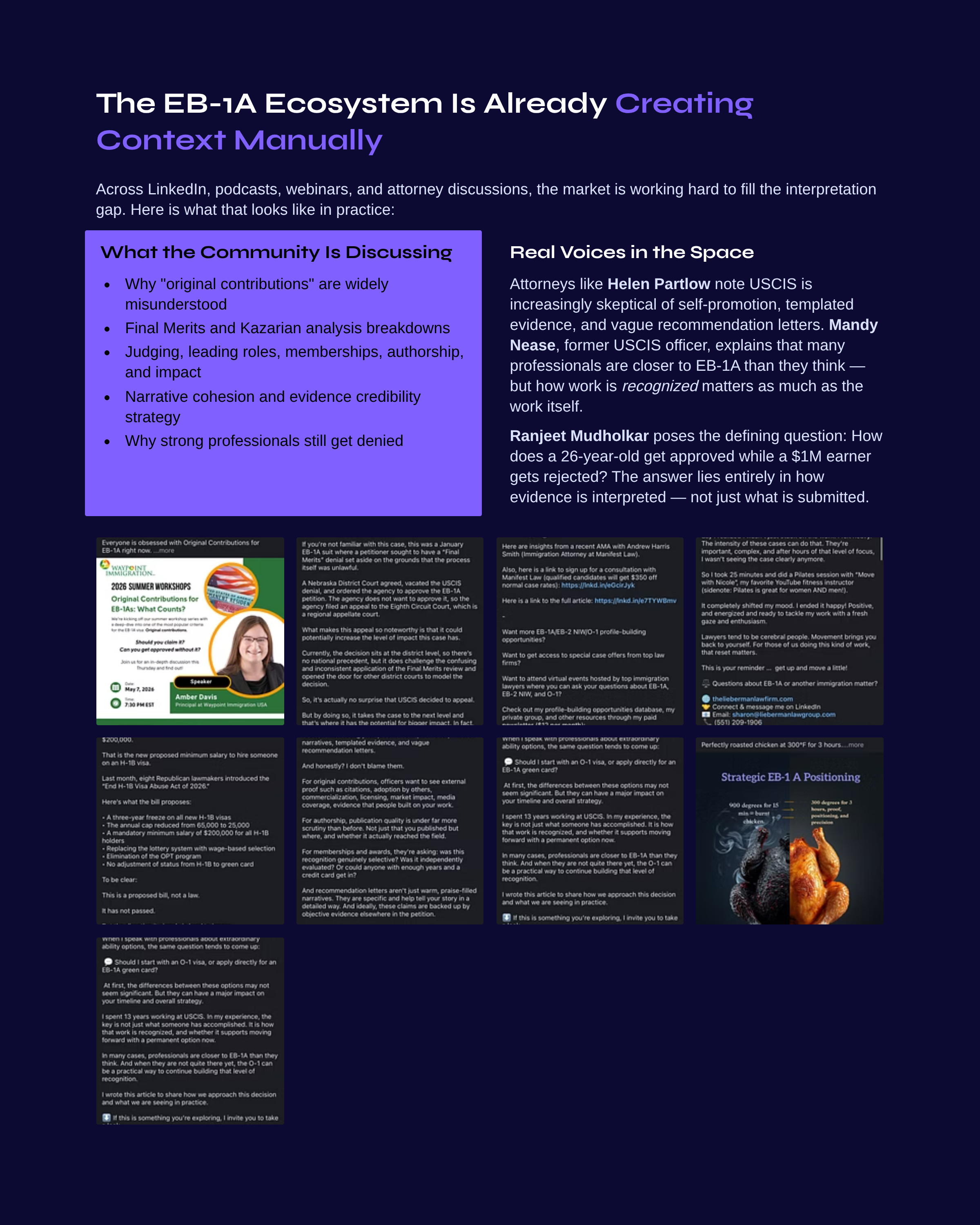
Across the EB-1A ecosystem, people are already building “context layers” manually.
Not through software. Not through structured systems. But through years of accumulated interpretation.
Every webinar from an immigration attorney. Every podcast breakdown of a difficult RFE. Every LinkedIn post discussing “original contributions.” Every AAO case analysis. Every conversation explaining why one engineer was approved while another with a stronger salary was denied.
All of this is contextual intelligence.
And today, that intelligence lives in fragmented human interpretation.
The Real Problem Was Never Just Documents
Most EB-1A applicants do not lack evidence.
They lack interpretation structure.
A typical applicant already has:
Publications
Patents
Citations
Awards
Media mentions
Leadership experience
Recommendation letters
Open source contributions
Startup impact
Internal company influence
But immigration evaluation is not simply about collecting files.
It is about understanding:
What does this evidence actually signal?
Does it show originality or only participation?
Is the impact objective or self-promotional?
Is the recognition independent?
Does the narrative feel credible and cohesive?
What risks would an adjudicator immediately notice?
That interpretation layer is where most of the real work happens.
And right now, attorneys build that layer manually.
The Market Is Already Teaching Applicants Context
The EB-1A ecosystem has slowly evolved into a distributed education network.
Attorneys explain:
why “leading role” evidence fails
why recommendation letters sound templated
why judging evidence is misunderstood
why salary alone is weak
why original contributions require external validation
why strong professionals still receive denials
Former USCIS officers discuss:
adjudicative reasoning
credibility indicators
narrative consistency
evidence weighting
how officers interpret significance
Applicants spend months consuming this information trying to understand one thing:
“What does my evidence actually mean in the eyes of immigration review?”
That question is the real market gap.
The Hidden Cost of Manual Interpretation
Today, most case preparation begins with isolated documents.
PDFs. Google Drive folders. Screenshots. Resumes. Loose recommendation drafts. Links. Email chains.
Then attorneys manually reconstruct meaning from scattered information.
This creates friction everywhere:
onboarding delays
repeated clarification cycles
narrative inconsistency
evidence duplication
missing context
late-stage risk discovery
avoidable RFEs
The problem is not lack of intelligence.
The problem is that intelligence is not structural.
Meritocrat: Turning Context Into Structured Evaluation Metadata
This is the problem Meritocrat was built to explore.
Instead of treating evidence as isolated files, Meritocrat attempts to structure the interpretation layer itself.
The idea is simple:
What if contextual immigration knowledge could become structured metadata attached to evidence?
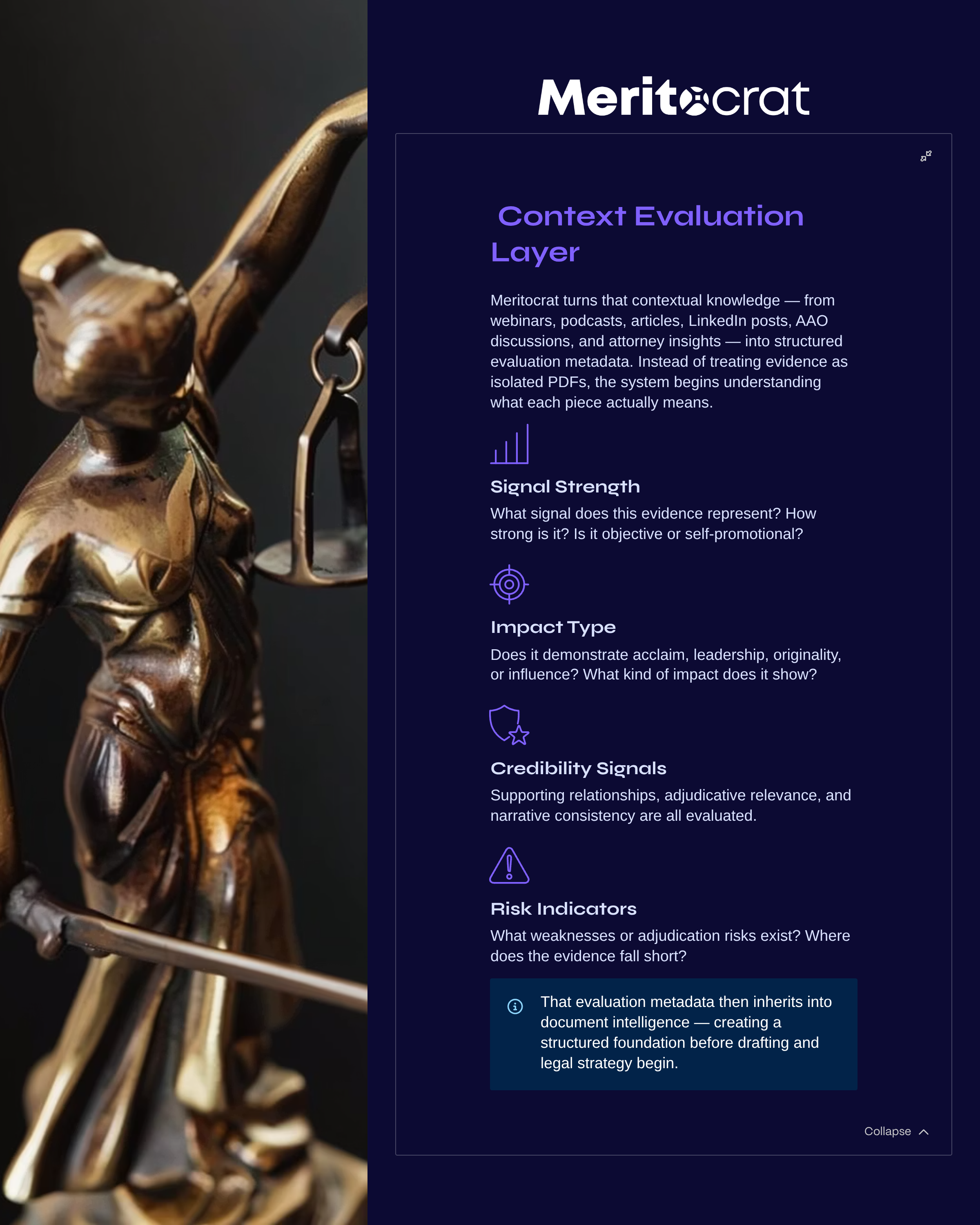
Instead of simply uploading a document, the system evaluates:
signal strength
impact type
credibility indicators
adjudicative relevance
narrative cohesion
risk indicators
That evaluation then inherits into document intelligence.
The document stops being “just a file.” It becomes contextual evidence inside a legal preparation workflow.
From File Storage to Case Intelligence
Traditional systems organize documents.
But evidence-based immigration requires something deeper.
Attorneys are not only managing files. They are building strategic interpretation.
That means:
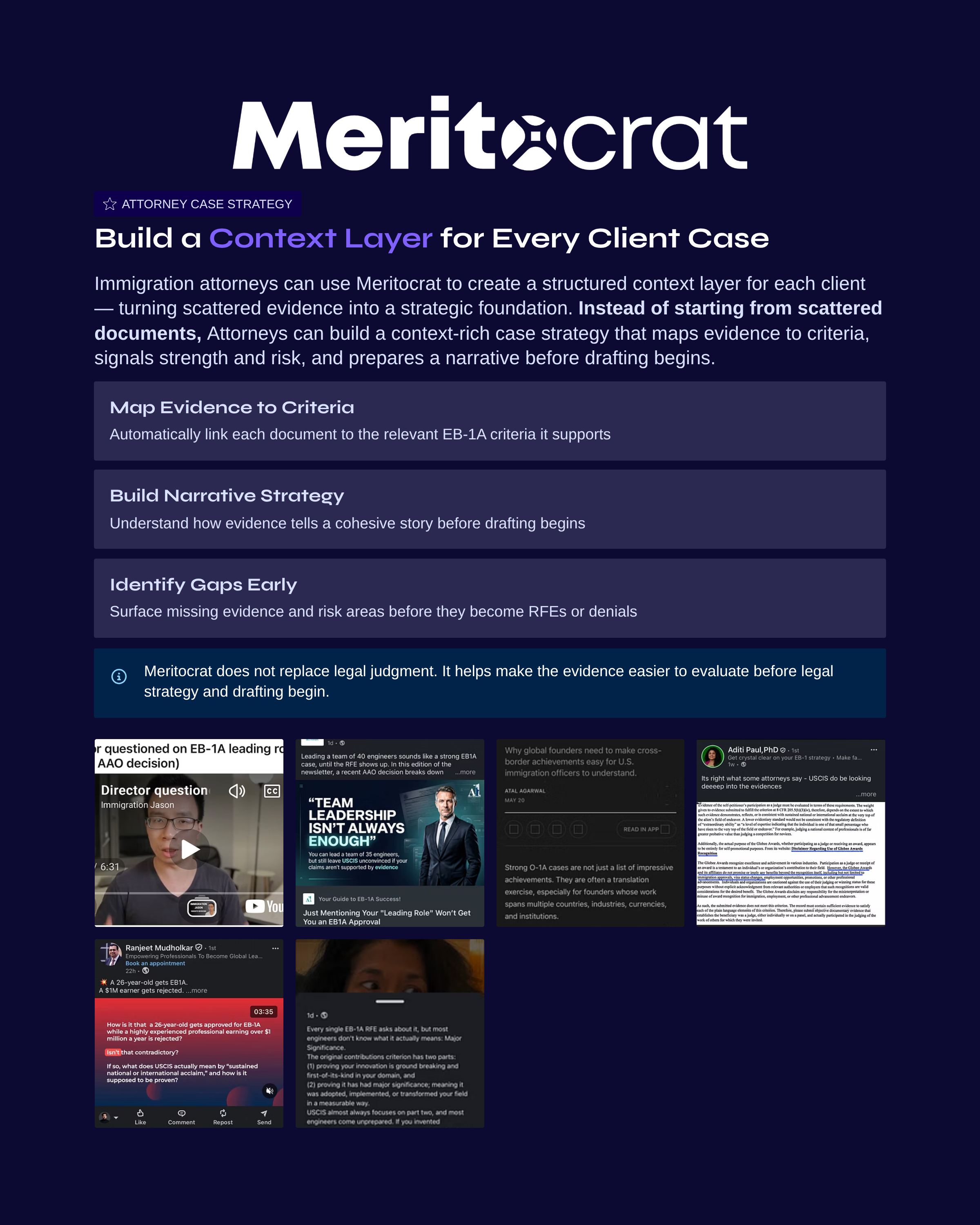
mapping evidence to criteria
understanding narrative gaps
evaluating credibility
identifying weak signals early
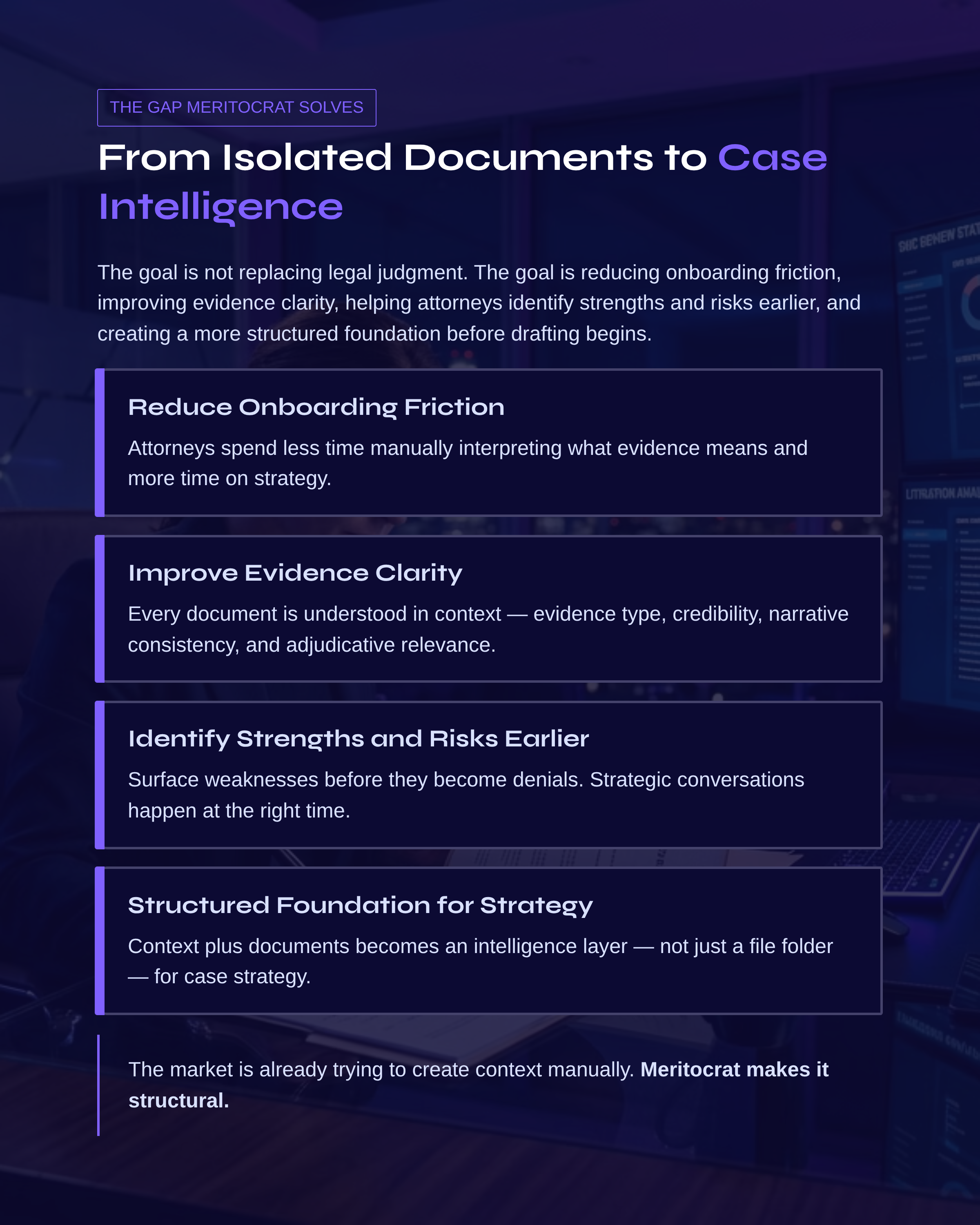
preparing positioning before drafting begins
The strongest attorneys already do this mentally.
Meritocrat attempts to make that structure visible.
The Goal Is Not Replacing Attorneys
This is important.
The goal is not automating legal judgment.
The goal is reducing preparation friction before legal strategy begins.
Attorneys still decide:
whether a case is viable
how evidence should be positioned
which criteria matter most
how narrative strategy should evolve
what legal arguments should be made
But if the underlying evidence is already structured clearly, attorneys can spend less time reconstructing context and more time applying expertise.
The Future of EB-1A Preparation Is Probably Context-Aware
The immigration industry already understands this implicitly.
That is why:
attorneys publish interpretation content
applicants obsess over AAO decisions
webinars focus on “how officers think”
former USCIS officers are increasingly consulted
community discussions revolve around evidence meaning rather than document count
The ecosystem is already creating context manually.
The next phase is likely making that context structural.
And that is the direction Meritocrat is exploring.
Prepare your case in one connected workspace
Case Studio helps EB-1A, EB-2 NIW, and O-1 applicants organize evidence and review what supports each claim.