News
What DHS and USCIS have actually changed since January 2025 — and what it costs the people standing in line
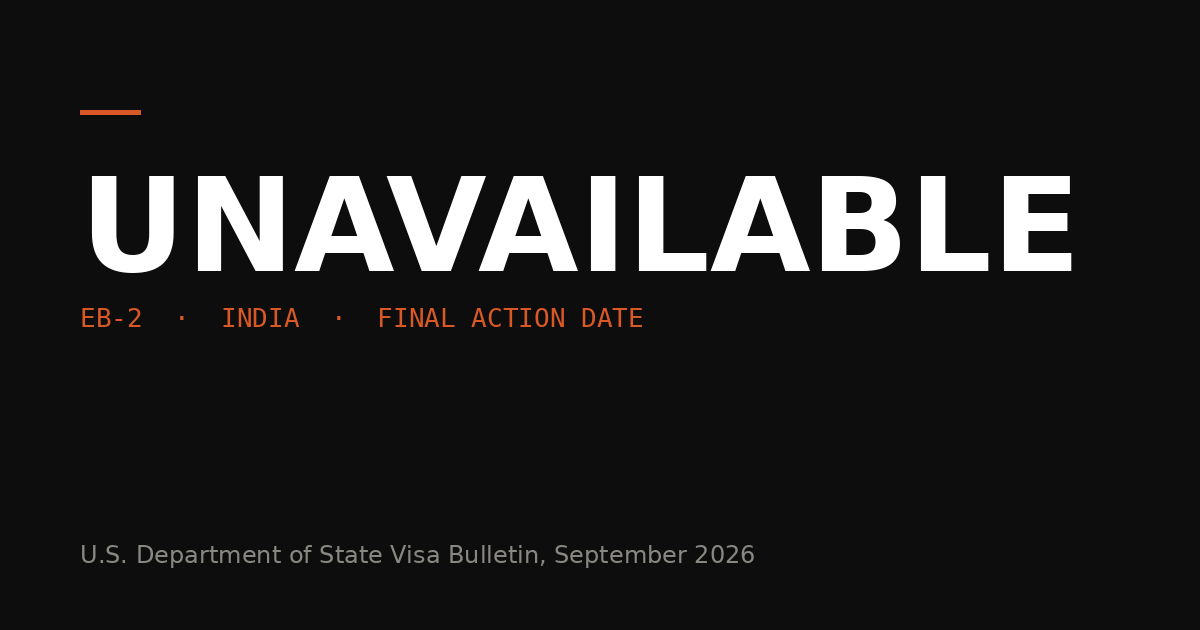
Open the State Department’s Visa Bulletin for September 2026 and find the row for EB-2, the employment-based category for people with advanced degrees.
January 2025: The Month Everything Changed in Immigration
Open the State Department’s Visa Bulletin for September 2026 and find the row for EB-2, the employment-based category for people with advanced degrees. Run your finger across to the column marked India.
It doesn’t give a date. It says UNAVAILABLE.
It has said that since the July 2026 bulletin, when India exhausted its share of EB-2 numbers for the fiscal year. It will say it through September 30. In the neighboring row, EB-3 India sits at January 1, 2014 — meaning that a worker whose employer filed for them on January 2, 2014 is still waiting, twelve and a half years later, for a number to come free.
That is not a delay. That is a closed door with a sign on it, and it is only one line in a very long document.
I don’t have to look far for this. A friend of mine got his EB-1A approved in March 2025 — extraordinary ability, the category reserved for people at the top of their field. He’d built the case over years: the awards, the citations, the letters. It came through. For a few months, he had done the hardest part.
Then, in January 2026, his employer laid him off. Severance, a clean exit on paper — one more name in a tech layoff cycle that didn’t ask what visa category anyone was in.
Here is the part that doesn’t fit on a bumper sticker: winning the green card case did not mean he had the green card. On the Visa Bulletin, his priority date was current on the Dates for Filing chart — current enough that he’d been able to file his adjustment of status — but not current on the Final Action Date chart, the one that actually issues the card. He was inside the process. He was not through it. And an approved I-140 doesn’t feed you or keep your status valid by itself; you still need a job and a lawful nonimmigrant category to stand on while the number you’re waiting for makes its way down the list.
So he did what his attorney told him to do: he went back to H-1B, and searched for a new employer willing to sponsor it, in a market that was busy laying off exactly this kind of worker. Not because his EB-1A wasn’t good enough — USCIS had already said it was — but because “approved” and “arrived” turned out to be two different words in this system, separated by a wait with no calendar on it.
He found something. He’s working again. But I think about the sequence often: recognized, by his own government, as extraordinary — and still, months later, cold-emailing recruiters to keep the right to stay in the country that had just said so in writing.
What actually changed
I want to be careful here, because the loudest version of this story is usually the least accurate one. So: only what is documented, with the receipts.
The system got slower, and much bigger. Between the first quarter of FY2025 and the first quarter of FY2026, USCIS’s pending caseload rose from 9.7 million to 11.3 million. Case completions fell 40.8 percent year over year. The average time to clear the backlog roughly doubled, from 9.4 months to 18.6 months. The overall denial rate went from 8.9 percent to 12.2 percent. (American Immigration Council, August 5, 2026)
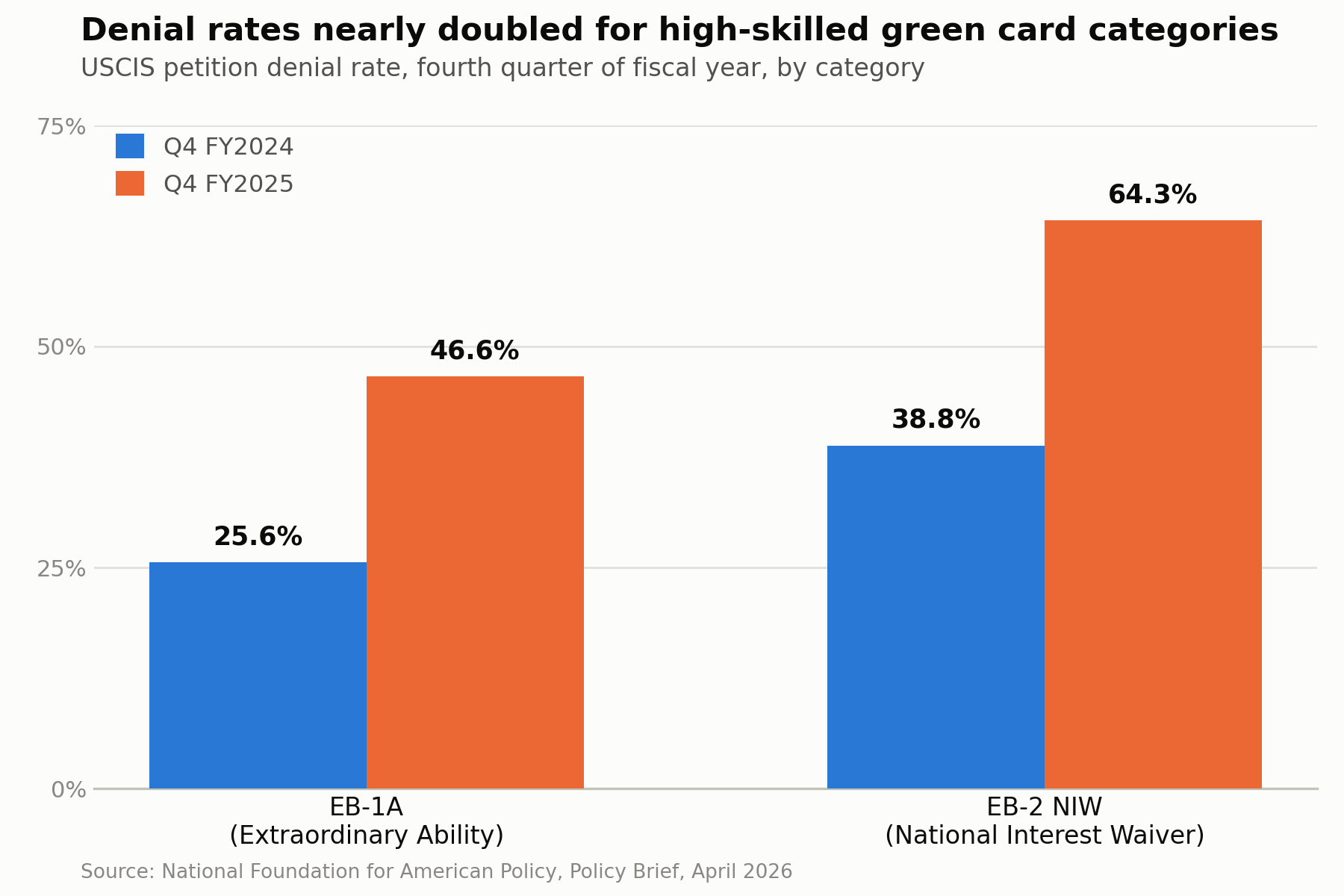
Approvals in the high-skilled categories collapsed. The National Foundation for American Policy found that between the fourth quarter of FY2024 and the fourth quarter of FY2025, denial rates for EB-1A extraordinary-ability petitions went from 25.6 percent to 46.6 percent. For the EB-2 National Interest Waiver, from 38.8 percent to 64.3 percent. NFAP’s own reading: “A change of that magnitude indicates USCIS political leadership encouraged a crackdown on approvals.” (NFAP, April 2026) Notably, H-1B denials did not spike — they held around 2 percent. The squeeze is on permanent residence, not temporary work.
The safety net under work permits was removed, twice. On October 30, 2025, DHS published an interim final rule eliminating the automatic extension — up to 540 days — that had let people keep working while a renewal was pending. It applies to renewals filed on or after that date, and it covers H-4 and L-2 spouses and people with pending green card applications. Five weeks later, on December 5, USCIS cut the maximum validity of new work permits from five years to eighteen months for asylees, refugees, parolees and adjustment applicants, explaining that “vetting an alien more often will enable USCIS to deter fraud.”
Put those two together with EAD processing times that reached 10.2 months in FY2025, and you get the arithmetic that people are actually living: file the renewal, wait, and if the card expires first, stop working. There is no longer a bridge.
Children lost ground. On August 15, 2025, USCIS reverted its Child Status Protection Act age calculation to the Final Action Dates chart rather than the more generous Dates for Filing chart. In a year when EB-2 India is unavailable and EB-3 India sits in 2014, that arithmetic decides whether a nineteen-year-old is still a dependent at twenty-one or has to find their own status. USCIS published no estimate of how many children this affects. The most-cited number, from Cato’s David Bier in 2020, put 253,293 children in the employment-based backlog with roughly 104,000 projected to age out — more than four in five of them Indian.
The price of an H-1B went up, then didn’t, then went up again. A September 19, 2025 proclamation imposed a $100,000 payment on certain new H-1B petitions. By February 15, 2026, only 85 payments from 70 employers had actually been made. On June 8, 2026, Judge Leo Sorokin of the District of Massachusetts vacated it, holding the charge “was not an immigration restriction, but rather a tax, which the president lacked authority to impose.” The First Circuit declined to stay that ruling on July 24.
Then, on August 25, 2026 — yesterday, as I write this — DHS published a proposed rule imposing a $103,265 fee on every cap-subject H-1B petition, this time through notice-and-comment rulemaking under fee-recovery authority rather than by proclamation. Comments close September 24. Bo Cooper of Fragomen did the multiplication for Bloomberg: “For a company that wants to hire 100 H-1Bs, that’s roughly a $10.3 million filing fee bill.”
And the lottery isn’t a lottery anymore. A final rule published December 29, 2025 replaced random selection with wage-weighted selection — four entries for a Level IV wage, one for Level I. It was used for the first time in March 2026. Registrations fell 38.5 percent, to 211,600.
There is more. Naturalization now requires a redesigned civics test — 20 questions asked instead of 10, 12 correct to pass — for applications filed on or after October 20, 2025. USCIS revived neighborhood investigations under a dormant 1940s provision, meaning unannounced visits to an applicant’s home and workplace. A May 21, 2026 policy memo recast adjustment of status as “an act of administrative grace,” telling officers they “may deny cases even where the applicant otherwise meets the technical eligibility requirements.” A rule taking effect September 15 ends “duration of status” for students, caps admission at four years, and cuts the departure grace period from 60 days to 30. A proposal now sitting at OMB would eliminate the 60-day grace period after a layoff for H-1B, L-1, E and TN workers entirely.
The Migration Policy Institute counted more than 500 immigration actions in the administration’s first year — more than the 472 taken across the entire first term.
What it looks like when it lands on one person
Suguru Onda, a Japanese PhD student at BYU, had his student record terminated in April 2025. The apparent trigger was a 2019 citation for catching too many fish on a church outing — a citation that had been dismissed. It was restored, reportedly within minutes of his lawsuit being filed. (Deseret News)
Priya Saxena, a doctoral student at South Dakota Mines, had her visa revoked over a 2021 traffic stop where her blood tests came back within legal limits and no DUI was ever charged. A federal judge granted a restraining order; she walked at her graduation and finished her PhD while DHS was trying to remove her. (KOTA-TV)
Krish Lal Isserdasani was eight days from graduating from UW-Madison when his record was terminated over a disorderly conduct arrest prosecutors had declined to charge. His family had spent about $240,000 on his education. A judge stopped it. (Wisconsin Examiner)
Fabian Schmidt, a German citizen and a green card holder since 2008, was detained at Boston Logan in March 2025 returning from visiting his father, and held roughly two months. The ground cited in his notice to appear turned out not to exist. (NHPR)
Sridhar Vanka spent fourteen years in the United States and was a technical program manager at Meta when he was laid off in May 2026. He could not find a sponsor inside the 60-day window. He moved his family to India. He described the years as “optimism, hope, uncertainty, anxiety, heartbreaks and waiting,” and the last weeks as gut-wrenching. (IBTimes UK)
Mark Tonelli, a music professor in Illinois, learned that he and his Brazilian wife Luciana had qualified for their final interview on January 21, 2026 — the exact day the State Department suspended immigrant visas for nationals of 75 countries on public charge grounds. “It’s been agonizing every day,” he said, “just waiting and wondering when my wife will finally be able to come home.” (WBEZ) That suspension was struck down on August 22, 2026 by Judge Jeannette Vargas in the Southern District of New York, who wrote: “In many ways, this is not a challenging case.”
Every one of those people was here legally. Most of them won. Winning took a lawyer, a lawsuit, and a federal judge.
The case for the other side, stated fairly
It would be dishonest to write all that and pretend there is no argument on the other side, so here is theirs, in their own words rather than mine.
The government’s position is that this is what enforcement of an existing law looks like after a period of under-enforcement. USCIS Director Joseph Edlow has said that “at its core, USCIS must be an immigration enforcement agency.” A DHS spokesperson, defending the pause on naturalizations for nationals of certain countries, put it plainly: “Citizenship is a privilege, not a right.” The September 2025 H-1B proclamation cited real numbers — foreign STEM employment rising from 1.2 million in 2000 to 2.5 million in 2019, IT workers going from 32 percent of H-1B usage to over 65 percent, one company approved for more than 5,000 H-1B workers in a year it announced more than 15,000 layoffs. The Labor Department’s proposed wage rule argues that employers have been permitted to “hire alien workers at wage levels below those that similarly employed U.S. workers were paid.”
Those are not frivolous claims, and the H-1B program has documented abuse — the Labor Department’s Project Firewall had at least 175 open investigations and roughly $15 million in assessed back wages as of November 2025. A country is entitled to set numerical limits, and limits mean lines, and lines mean waiting. My own discomfort in a queue is not by itself an argument that the queue is wrong.
What I would say back is narrower. Almost none of the changes above are about the size of the line. They are about the conditions of standing in it — whether your work permit survives the wait, whether your child ages out during it, whether a decision your employer made in 2014 still governs your life in 2026. You can believe in strict limits and still think a person should be able to keep working while the government takes eighteen months to open their file.
Why even the lawyers are drowning
This is the part I keep coming back to, because it’s the part that surprised me.
Andrew Nietor, writing on AILA’s own blog in May 2026, described a practice in which “policies shift without warning, and even experienced practitioners struggle to predict how agencies will behave from one week to the next,” and where attorneys are “asked to advise families, workers, asylum seekers, and employers in an environment where [the system] often appears intentionally unstable.” His conclusion: “Much of our work now involves helping clients navigate the growing uncertainty, with little reliable authority to anchor our advice.” (AILA Think Immigration)
Gabe Harrison, an attorney in Bellingham, Washington, described the advice problem exactly: “In certain circumstances, we can say we haven’t seen it in this class of people. You’re safe, most likely. But then the next day, that same class of people might be vulnerable.” (Cascadia Daily News)
Brittni Rivera, in Chicago: “The landscape has changed to the point where immigration attorneys have to be on the defense 24/7 for a case, and it’s just not sustainable.” (Borderless Magazine)
And the churn is visible in the courts. TRAC at Syracuse counted 41,887 federal civil immigration lawsuits filed in the twelve months ending March 2026 — 9,911 in the month of March alone, against 945 in March 2025. (Most of that surge is detention habeas petitions rather than benefits litigation, so read it as a measure of enforcement volume, not of paperwork disputes.) (TRAC)
Meanwhile the rules keep moving underneath everyone. In December 2025, USCIS froze benefit adjudications for nationals of 19 countries and paused asylum decisions nationwide; by January the freeze covered 39. On June 5, 2026, Chief Judge John McConnell in Rhode Island vacated four of those policies, writing that applicants had been “trapped in an indefinite legal limbo … solely by the happenstance of their birth,” and that the power to regulate entry “does not extend to domestic processing of immigration benefit requests.” On August 14, 2026, the First Circuit stayed part of that ruling, letting the re-review of already-approved cases resume.
If you are trying to answer the question what is the rule right now, that sequence is the answer: it depends what day you’re asking, and which circuit you’re in.
So what would actually fix it
I don’t know, and I’ve stopped trusting people who say they do. The honest thing is to lay out the options and admit they conflict.
Maybe it’s the statute. The per-country cap — no country gets more than 7 percent of the annual allotment regardless of population — is why an Indian engineer and a Belgian engineer with identical qualifications face waits that differ by decades. That’s not an agency decision. Congress wrote it, Congress could unwrite it, and bills to do so have died in every session for twenty years.
Maybe it’s much less glamorous than that. Fund the agency to match its caseload. Publish honest timelines. Restore some bridge under work authorization so a processing delay doesn’t become a job loss. Stop rewriting guidance quarterly, so that people can at least plan around a rule they dislike. None of that requires agreeing about how many immigrants the country should take. It only requires deciding that the wait shouldn’t randomly destroy the people in it.
Maybe the honest answer is that this is a political choice and it’s been made. Voters elected an administration that campaigned on exactly this. Some of what’s happened is straightforwardly popular. If you think the current numbers are too high, most of the last eighteen months looks less like dysfunction and more like a policy working. That’s a real position held by a lot of people and it deserves to be answered rather than dismissed.
I keep landing on a smaller question than any of those, and I’ll leave it here open, because I don’t have the end of it:
If a system is too complicated for the attorneys who practice in it full-time to predict from one week to the next — and too unstable for the people whose entire lives sit inside it to plan around — is that a problem to be fixed? Or is that just what a border looks like from the inside?
I’ve been waiting long enough to want an answer. I’ve been waiting long enough to distrust the easy ones.
If you’re in this queue too, I’d like to hear what it’s actually cost you. The comments are open.
Every factual claim in this piece is sourced and dated. If you find an error, tell me and I’ll correct it in place with a note. Policy in this area changes weekly; figures are current as of August 26, 2026.
Sources
USCIS Immigration Processing Trends 2026 — American Immigration Council
Employment-Based Immigration report — American Immigration Council
Analysis of USCIS Denial Rates for High-Skilled Immigrants — NFAP, April 2026
Removal of the Automatic Extension of Employment Authorization Documents — Federal Register
Fee for Certain H-1B Petitions (proposed rule) — Federal Register, Aug 25, 2026
Weighted Selection Process for Cap-Subject H-1B Petitions — Federal Register
USCIS reverts to more restrictive child age-out calculation — Fragomen
When Chaos Is the Strategy — Andrew Nietor, AILA Think Immigration
Surge in Immigration Lawsuits Hits Record High in 2026 — TRAC Syracuse
Immigration in the First Year of Trump 2.0 — Migration Policy Institute
Rhode Island federal court vacates USCIS benefit freeze policies — Nixon Peabody
Former South Dakota Mines student sues after visa revoked — KOTA-TV
Judge blocks termination of UW-Madison student’s visa — Wisconsin Examiner
Preparing clients for the 2025 naturalization civics test — CLINIC
This article is general information, not legal advice. Meritocrat is a preparation tool, not a law firm, and does not replace qualified legal counsel.
Prepare your case in one connected workspace
Case Studio helps EB-1A, EB-2 NIW, and O-1 applicants organize evidence and review what supports each claim.