How it works
How Meritocrat builds context from AAO adjudications.
Meritocrat's knowledge graph is built from real-world cases and AAO adjudications. Here is how that context is built, and what it means for your EB-1A, EB-2 NIW or O-1A preparation.
Watch: how context is built
An 80-second walkthrough, from a public decision to your case.
Read the transcript
ChatGPT, Gemini and other AI tools are powerful. Ask them about EB-1A or a national interest waiver, and they will give you a clear, confident answer.
But employment-based immigration is not decided by general knowledge. It is decided by details: this month's Visa Bulletin, the current rules, and how an officer reads your exact evidence. A general AI answers from everything it has read. That can mean outdated dates, mixed-up sources, or a citation that sounds real but isn't.
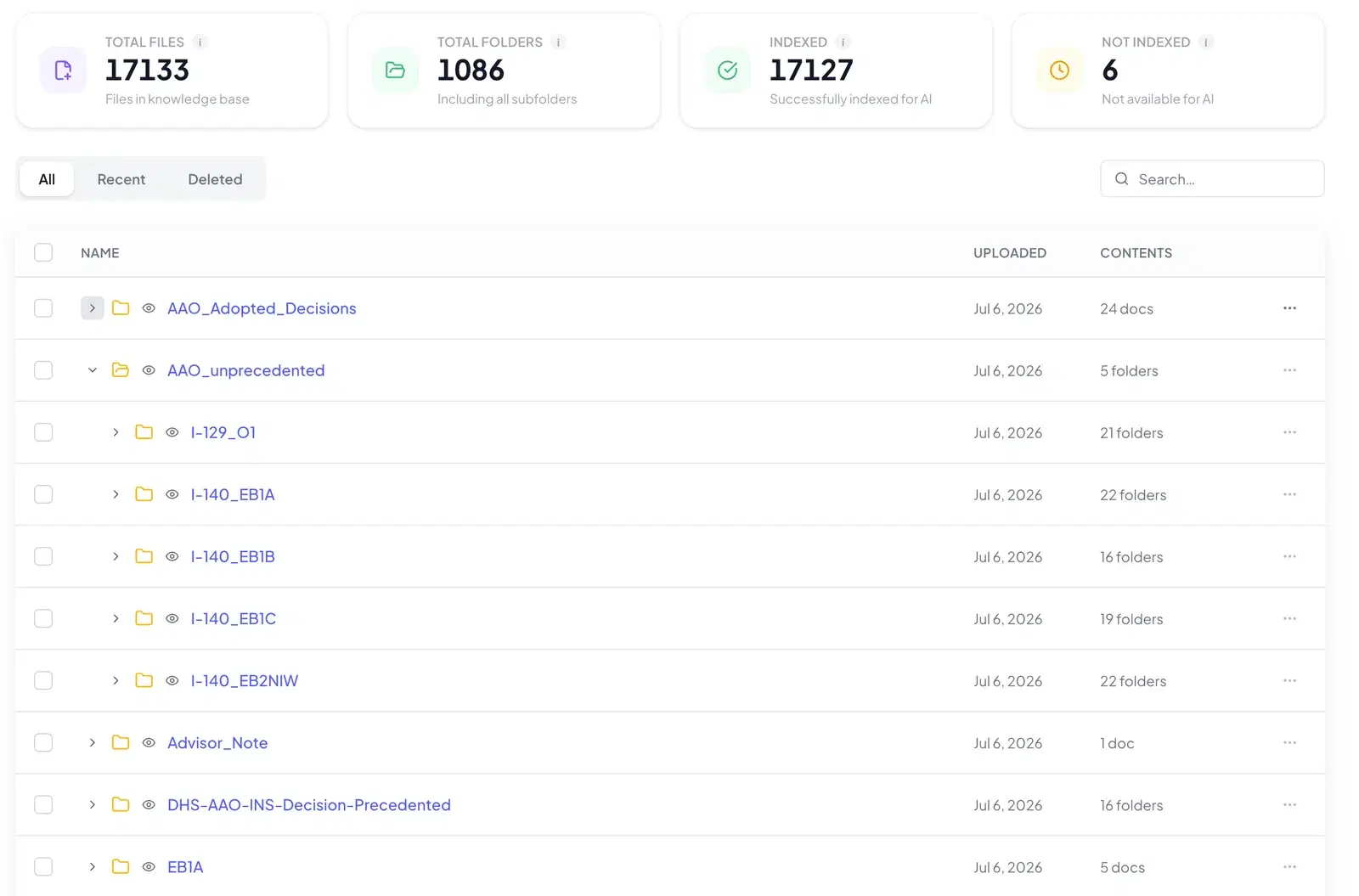
At Meritocrat, we start somewhere more specific. We keep immigration decisions in separate groups: precedent decisions, adopted decisions, and non-precedent AAO decisions, sorted by form and category, from I-140 for EB-1A, EB-1B, EB-1C and EB-2 NIW, to I-129 for O-1. A precedent decision and a one-off appeal outcome do not carry the same weight, so we keep them apart.
Then we read your evidence against that context, so you can see where it is strong, where it is thin, and where it is missing. You review every step.
One case never predicts another. Meritocrat is a preparation tool, not a law firm.
From a public decision to your case
Start from public decisions
The Administrative Appeals Office publishes non-precedent decisions on I-140 and I-129 petitions. We read decisions for EB-1A, EB-2 NIW and O-1A.
Read and de-identify
We add real cases from primary documents and applicant reports, and remove names, employers, receipt numbers, officer codes and law firms.
Organize by visa and standard
Each finding is tied to the visa type and to the criterion or prong the officer or appeals office addressed.
Use it as context for your case
When you build a case, your evidence is read against this context so you can see where it is strong, thin or missing. You review every step.
Inside the knowledge base
Decisions are kept in separate groups, so you can tell a precedent decision from a one-off appeal outcome.
One method, three standards
The context follows the standard each visa is judged against.
Extraordinary ability
EB-1A
The standard
A one-time major achievement, or evidence for at least three of ten criteria, followed by a final merits review of the whole record.
What the context adds
Decisions show how officers read each criterion and where a record fails the final merits review.
National interest waiver
EB-2 NIW
The standard
The Dhanasar framework: substantial merit and national importance, being well positioned to advance the endeavor, and a balance that favors waiving the job offer.
What the context adds
Decisions show how the proposed endeavor and the three prongs are weighed.
Extraordinary ability, nonimmigrant
O-1A
The standard
A major internationally recognized award, or evidence for at least three of eight criteria.
What the context adds
Decisions show how the criteria are applied to temporary, project-based work.
What this context cannot do
- One case does not predict another. Outcomes depend on your evidence and on the adjudicator.
- AAO non-precedent decisions are specific to their facts and do not bind other cases.
- Cards from applicant forums are self-reported and unverified. We label them.
- Meritocrat is a preparation tool and not a law firm. It does not provide legal advice or promise approval.
See it applied to your evidence
Start with a free assessment, or browse the de-identified case library.