News
H-1B Will "Look Very Different" in 365 Days: What the Labor Department Watchdog Pointed Out, and Why Genuine Talent Can Stay Ahead
Labor Department Inspector General Anthony D'Esposito says the foreign labor visa program will look very different a year from now. What he said, what has already changed, and why the shift rewards genuine talent and strong evidence.
A single sentence from a government watchdog has sparked conversation across the H-1B community this week.
In an interview on The Benny Show with Benny Johnson on September 24, 2026, Department of Labor Inspector General Anthony D'Esposito closed with this line:
"The foreign labor visa program is going to look very different 365 days from now than it does today."
For many H-1B workers and employers, that sounds alarming. But listen to the points he made before it, and a clearer picture emerges: this is a crackdown on people who abuse the system, not on the professionals it was built for.
What D'Esposito pointed out
The Office of Inspector General is the Labor Department's independent watchdog. It investigates fraud, waste, and abuse. It does not write visa rules. Here are the main points he made in the interview, and what each one means for honest applicants.
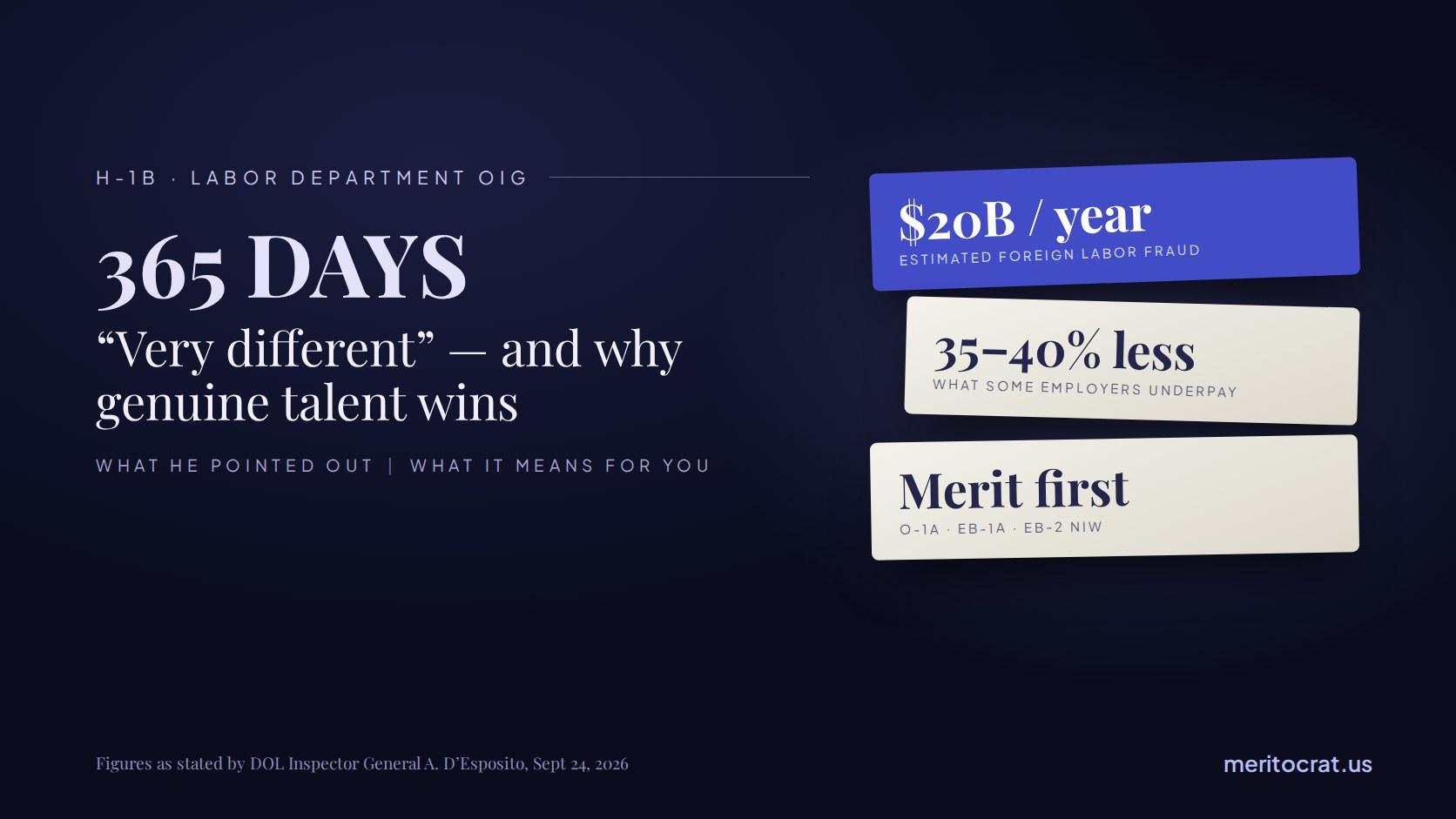
1. Foreign labor fraud is large. He put the cost of foreign labor fraud in the United States at "at least $20 billion a year." He also stressed that this is "not a paperwork accounting issue, that this is real." What it means: Money and visa slots lost to fraud are resources taken away from genuine workers and employers. Recovering them strengthens the program for everyone who plays by the rules.
2. Some employers underpay foreign workers. He said "there are some shady business owners that want to put more money in their pocket," paying H-1B workers "35 and 40% less than an American worker." What it means: This is a worker-protection point as much as an enforcement one. Underpaying foreign workers hurts them and undercuts American workers too. Enforcing fair wages is good news for H-1B professionals.
3. Action is already underway. He described search warrants, dozens of subpoenas, and tips from whistleblowers and the public through Department of Labor hotlines. He named Cognizant and Cloudera as companies that had been suspended. News reports indicate the Department of Labor suspended their new PERM filings, the labor certification step for employment-based green cards, in early September as part of an investigation. That is an investigative action, not a finding of wrongdoing. What it means: Enforcement is targeted at specific employers under investigation, not at every worker in the program.
4. It is a whole-of-government effort. He described coordination across the Department of Justice, the FBI, the State Department, and health agencies, and said more company suspensions could follow. What it means: Expect more oversight and more data sharing. Employers with clean, accurate filings have little to fear from this.
5. The fraud is already shrinking. He noted a "downward spiral in applications for these foreign labor visas" since the investigations began, and warned that people breaking the law cannot escape: "there's no country you could hide in." What it means: When bad actors step back, fewer questionable petitions compete with legitimate ones.
6. The program will change within a year. His closing message: the program "is going to look very different 365 days from now than it does today." He did not announce a specific new rule. What it means: Change is coming through enforcement and policy, and it points toward real jobs, fair pay, and verified employers.
What has already changed
D'Esposito's comments follow a series of concrete actions:
| Action | What it does |
|---|---|
| Executive order, September 18, 2026 | Directs the Departments of State, Labor, and Homeland Security to coordinate with Commerce, Education, and the Small Business Administration on H-1B data such as wages and employment. Officials must consider an employer's recent or planned layoffs of similar U.S. workers. |
| Proclamation, September 18, 2026 | Extends the $100,000 payment requirement for certain new H-1B petitions for workers outside the United States through September 21, 2027. |
| Court ruling on the $100,000 fee | A federal court in Massachusetts vacated the policy implementing the fee on June 8, 2026, and the First Circuit declined to pause that ruling on July 24, 2026. For now, the fee remains blocked. |
| Wage-based selection for FY2027 | The H-1B lottery now favors higher-wage positions. The White House reports that overall registrations fell nearly 40% after the change. |
Why this can be good news for genuine talent
It is natural to read "very different" as "harder." But look at who these changes are aimed at.
1. Fraud crowds out honest applicants. Fake employers and non-existent jobs take petitions, lottery chances, and government attention away from real workers. Cleaning that up makes room for people with legitimate offers.
2. Fewer, stronger registrations. With wage-based selection, registrations dropped sharply. When fewer low-quality or speculative registrations enter the pool, skilled professionals in well-paid roles face less crowding.
3. Better protection for workers. The investigations target arrangements that exploit workers. A system with stronger oversight is one where H-1B professionals are less likely to be underpaid, misplaced, or left without the job they were promised.
4. Clearer expectations for employers. Employers that pay fairly, place workers in real roles, and keep good records are exactly what the new oversight rewards. The rules are becoming stricter, but also more predictable for those who follow them.
5. The courts are still a check. The blocked $100,000 fee shows that major changes are reviewed by the courts. Changes are coming, but through a process with limits.
What to do in the next 365 days
The coming year is a good time to prepare, not panic.
- Keep your records clean. Make sure your job title, duties, worksite, and salary match what was filed. Keep pay stubs, offer letters, and project documents in one place.
- Know your employer's situation. Layoffs of similar U.S. workers may now be considered in H-1B decisions. It is worth understanding how that applies to your role.
- Watch official sources, not headlines. Rely on USCIS, the Department of Labor, and the Department of State for actual rule changes.
- Look beyond the lottery. If you have a strong record of achievement, evidence-based pathways may give you more control over your future.
The pathways that reward merit, not luck
As the H-1B program tightens around real jobs and higher wages, three pathways stand out because they are built on individual evidence:
- O-1A: a temporary visa for people with extraordinary ability in sciences, business, education, or athletics. There is no annual cap and no lottery.
- EB-1A: a green card for extraordinary ability. You can petition for yourself, with no employer sponsor required.
- EB-2 National Interest Waiver: a green card for professionals whose work benefits the United States. You can also self-petition, without an employer-sponsored labor certification.
All three depend on one thing: how well your evidence proves your case. That is where preparation pays off. You can check which criteria your documents already support, find the gaps, and organize your case in Case Studio before you spend on legal counsel. For the latest green card dates, see our October 2026 Visa Bulletin analysis.
A year from now, the H-1B program may well look different. The professionals best placed for that change are the ones who start building their evidence today.
Sources
- The Benny Show, September 24, 2026 (episode transcript)
- Deccan Herald: US suspends Cognizant, Cloudera green card filings amid visa fraud probe
- Business Standard: US probes H-1B visa for fraud, plans 'very different' scheme in a year
- Business Today: 'Going to look very different in 365 days'
- Murthy Law Firm: Labor Inspector General predicts changes to foreign labor visa programs
- White House: Fact sheet on H-1B program integrity and interagency coordination
- Yale OISS: Proclamation extends H-1B $100,000 fee policy; fee remains blocked by court order
- Federal Register: Presidential documents, September 23, 2026
This article is general information, not legal advice. Quotes are from The Benny Show episode of September 24, 2026, and published reports of the interview. Meritocrat does not replace legal counsel. Consult a qualified immigration attorney about your specific situation.
Prepare your case in one connected workspace
Case Studio helps EB-1A, EB-2 NIW, and O-1 applicants organize evidence and review what supports each claim.