Analysis
October 2026 Visa Bulletin: EB-1 India Moves to February 2023, EB-2 India Returns, and EB-2 Rest of World Retrogresses
FY2027 opens: EB-1 India advances to February 2023, EB-2 India returns, EB-2 Rest of World retrogresses, and USCIS accepts the Dates for Filing chart for employment cases. What it means for EB-1A and EB-2 NIW applicants.
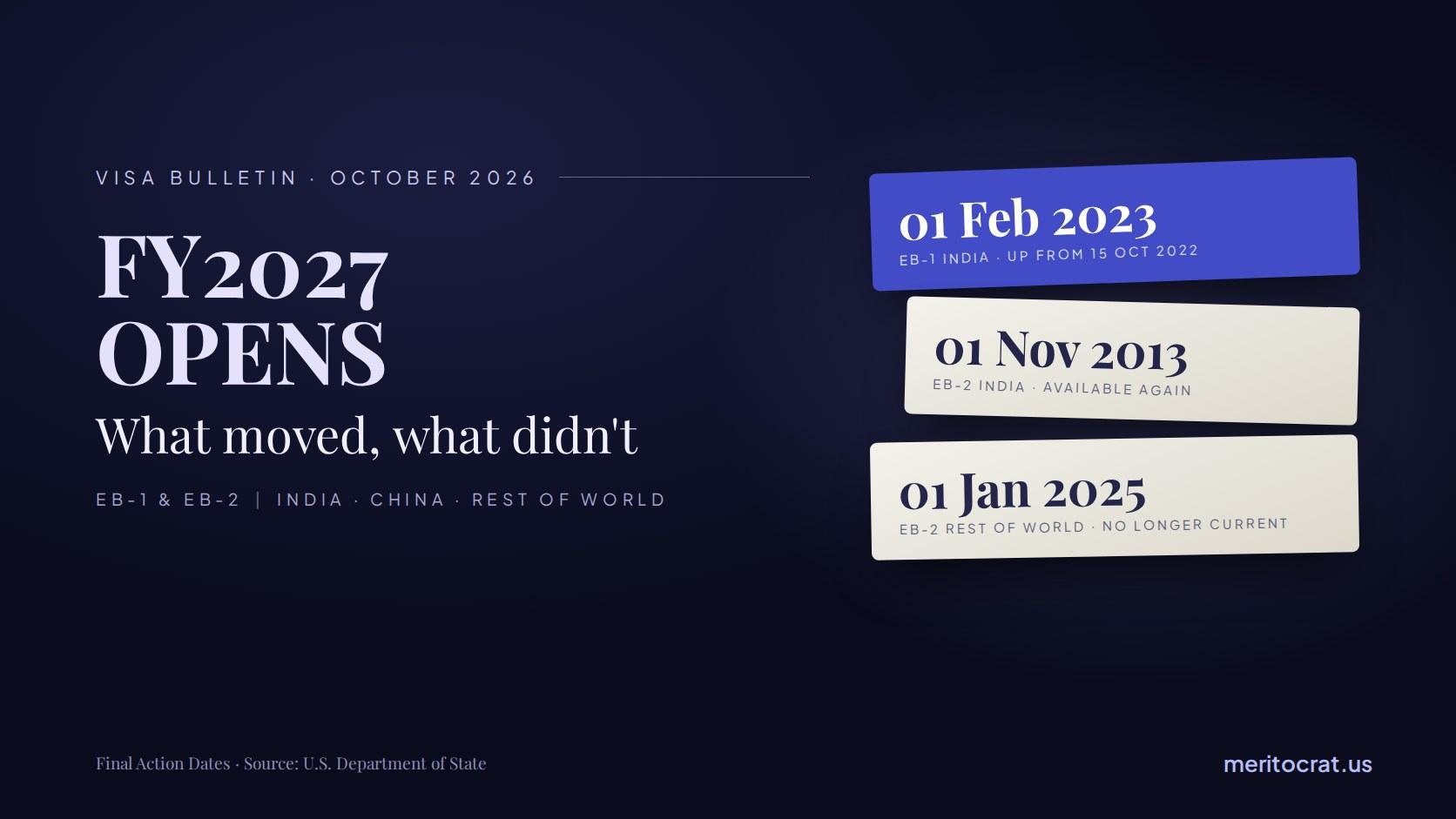
The Department of State has published the October 2026 Visa Bulletin, the first of fiscal year 2027. As expected, the new fiscal year brought fresh visa numbers and forward movement for several backlogged categories, including EB-1 India and EB-2 India.
It also brought a surprise that many applicants were not watching for: EB-2 for "Rest of World" is no longer current. The Department of State says some employment-based categories for Rest of World countries had to retrogress "to keep visa issuances within FY 2027 quarterly and annual limits."
Here is what changed, and what it means if you are preparing an EB-1A or EB-2 NIW petition.
The headline changes
| Category | September 2026 | October 2026 | Change |
|---|---|---|---|
| EB-1 India | 15 Oct 2022 | 01 Feb 2023 | Advances about 3.5 months |
| EB-1 China | 01 Jul 2023 | 01 Jul 2023 | No change |
| EB-1 Rest of World | Current | Current | No change |
| EB-2 India | Unavailable | 01 Nov 2013 | Available again |
| EB-2 China | 01 Sep 2021 | 01 Oct 2021 | Advances 1 month |
| EB-2 Rest of World | Current | 01 Jan 2025 | Retrogresses |
| EB-3 India | 01 Jan 2014 | 01 Jan 2014 | No change |
| EB-3 Rest of World | 01 Sep 2024 | 15 May 2024 | Retrogresses about 3.5 months |
Final Action Dates. Source: Department of State, Visa Bulletin for September 2026 and October 2026.
EB-1: India moves forward, China holds
EB-1 India advances from October 15, 2022 to February 1, 2023. It is a real step forward after the category retrogressed through the summer, but it stops short of April 1, 2023, the date it held in spring 2026.
We should be upfront: our October prediction named April 1, 2023 as the single best case. The actual date is two months earlier. Charlie Oppenheim's expectation of "early 2023" turned out to be closer. The Department of State opened the year more cautiously than a full return to the spring position.
The bigger move is on the Dates for Filing chart. EB-1 India and EB-1 China both jump from December 1, 2023 to July 1, 2024. If USCIS accepts that chart for October, many more EB-1 applicants from India and China can file their adjustment applications now.
EB-1 for all other countries remains current.
EB-2: India returns, Rest of World retrogresses
EB-2 India is available again, with a Final Action Date of November 1, 2013. That is below the July 15, 2014 date the July 2026 bulletin projected for October, and it lines up with Charlie Oppenheim's "mid-to-late 2013" expectation. EB-2 India's Dates for Filing stays at January 15, 2015. National Interest Waiver cases follow these same EB-2 dates.
EB-2 China edges forward one month to October 1, 2021. Its Dates for Filing jumps a full year, from January 1, 2022 to January 1, 2023.
EB-2 Rest of World is the change to watch. It was current in September. In October its Final Action Date is January 1, 2025, and its Dates for Filing is March 15, 2026. For EB-2 NIW applicants from most countries, a green card can now be approved only if the priority date is before January 1, 2025. Mexico and the Philippines follow the same EB-2 dates.
EB-3 and other categories
- EB-3 Rest of World retrogresses from September 1, 2024 to May 15, 2024. Its Dates for Filing, which was current, is now August 1, 2024.
- EB-3 India holds at January 1, 2014.
- EB-3 China moves slightly to January 8, 2022, while its Dates for Filing jumps to April 1, 2024.
- EB-5 India unreserved returns at December 1, 2023 after being unavailable in September.
- EB-4 holds at December 15, 2022, and its Dates for Filing advances two years to January 1, 2025. The religious workers category has been extended through December 11, 2026.
Which chart can you use to file?
The Visa Bulletin publishes two charts, but USCIS decides each month which one adjustment applicants in the United States must use. For October 2026, USCIS has confirmed that all employment-based and all family-sponsored preference categories must use the Dates for Filing chart.
That is a meaningful change for employment-based applicants. In September, they had to use the Final Action Dates chart. In October, they can file based on the earlier, more generous Dates for Filing chart.
| Category | Can file I-485 in October if priority date is before |
|---|---|
| EB-1 India | 01 Jul 2024 |
| EB-1 China | 01 Jul 2024 |
| EB-2 India | 15 Jan 2015 |
| EB-2 China | 01 Jan 2023 |
| EB-2 Rest of World | 15 Mar 2026 |
| EB-3 India | 15 Jan 2015 |
| EB-3 Rest of World | 01 Aug 2024 |
Dates for Filing chart, October 2026. EB-1 for Rest of World remains current.
This matters most for EB-1 India and China, where the Dates for Filing chart is about 17 months ahead of the Final Action Date. An EB-1 applicant from India with an approved or pending I-140 and a priority date before July 1, 2024 can file an adjustment application in October, even though the green card itself cannot be approved until the Final Action Date reaches their priority date. Filing an adjustment application generally also lets you apply for a work permit and travel permission while the case is pending. For how the two charts work, read our guide to Dates for Filing vs. Final Action Dates.
What this means for EB-1A and EB-2 NIW applicants
- Indian EB-2 NIW applicants now face a Final Action Date in late 2013. For many, EB-1A is still the more realistic path, if the evidence supports it.
- Rest of World EB-2 NIW applicants should no longer assume EB-2 is current. If your priority date is after January 1, 2025, approval will wait until the date moves.
- EB-1A applicants from most countries still face no wait on the Visa Bulletin. Your timeline depends on your I-140 and your evidence.
- The department warns that dates can move again. It says it is "continually monitoring" the situation and will make adjustments as needed.
The Visa Bulletin decides when you can file and be approved. It does not decide whether your petition is strong enough. If you are weighing EB-1A against EB-2 NIW, this is a good time to check which criteria your evidence actually supports. You can map your documents to the USCIS criteria and see your gaps in Case Studio before you spend on legal counsel.
Sources
- Department of State: Visa Bulletin for October 2026
- Department of State: Visa Bulletin for September 2026
- USCIS: October 2026 Adjustment of Status Filing Charts
- USCIS: Adjustment of Status Filing Charts from the Visa Bulletin
This article is general information, not legal advice. Meritocrat does not determine visa availability or replace legal counsel. Always confirm the current Visa Bulletin and the USCIS chart selection before filing.
Prepare your case in one connected workspace
Case Studio helps EB-1A, EB-2 NIW, and O-1 applicants organize evidence and review what supports each claim.