Applicants
I-140 Processing Time 2026: EB-1A and EB-2 NIW, Regular vs Premium
How long does an I-140 take? Published timelines vary a lot, and for good reasons. Here is how to read them, what premium processing does and does not do, and how to use the waiting time well.
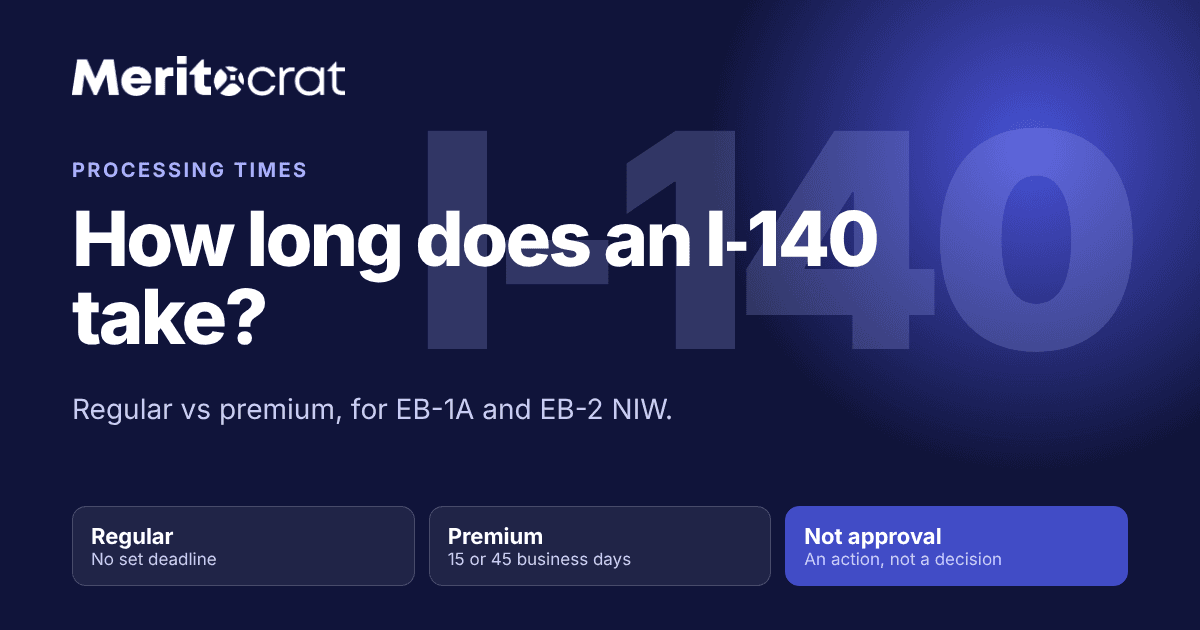
The most common question after filing an I-140 is also the hardest to answer: how long will it take?
If you search, you will find answers that differ by months. That is not because someone is wrong. Different sources measure different things. This guide explains how to read them, what premium processing really does, and how to use the waiting time.
This is general information, not legal advice. Check your own facts with an immigration attorney.
Why published times do not match
Three reasons explain most of the gap.
1. They measure different points. One source may report the median time for completed cases. Another may report the point by which about 80 percent of cases were finished. The second is always longer. Both can be correct.
2. They look at different cases. Times differ by category. EB-1A, EB-2 NIW, EB-1C and PERM-based cases do not move at the same pace.
3. They are about the past. Published times describe cases that have already been decided. Your case can be faster or slower depending on workload and on whether USCIS asks for more evidence.
USCIS also assigns cases to service centers by workload, and each center posts its own times on the USCIS processing times tool. Check that tool for the most current figure and treat everything else as an estimate.
Regular processing
Regular processing has no guaranteed deadline. You file the I-140 and wait. USCIS may approve, deny or issue a Request for Evidence, and an RFE pauses the case until you respond.
Because estimates vary by source, we do not give one number here. If a number matters for a decision, such as when your employer plans to file, ask your attorney what they are seeing on recent cases.
Premium processing
Premium processing lets you pay for a guaranteed action window using Form I-907.
| Category | Premium timeframe |
|---|---|
| EB-1A | 15 business days |
| EB-2 National Interest Waiver | 45 business days |
| EB-1C | 45 business days |
| EB-2 with PERM and EB-3 | 15 business days |
These windows come from law firm summaries of the USCIS premium chart. USCIS updates the chart periodically, so confirm the current window on the USCIS premium processing page before you file.
The fee. $2,965 as of March 1, 2026, in addition to the I-140 filing fee. USCIS adjusts premium fees periodically.
What it guarantees. It guarantees an action, not an approval. Within the window USCIS must approve, deny or issue a Request for Evidence. If it does none of these, it refunds the premium fee.
When the clock starts. The clock starts when USCIS accepts your I-907. If you upgrade a pending petition, it starts at that point, not on the original filing date. Only business days count, so weekends and federal holidays are excluded.
An RFE stops the clock. If USCIS issues an RFE, the premium window is considered met, and adjudication pauses until your response arrives. A new timeline starts when USCIS receives it.
Is premium processing worth it
It depends on your situation. It can help when you have a start date, a job change or a visa expiry to plan around. It will not fix a weak record. A faster decision on an incomplete case is still a decision on an incomplete case, and a denial or an RFE arrives sooner.
Questions to ask yourself:
- Is the time pressure real, with a date I cannot move?
- Is my evidence complete, and do I have a clear map from each exhibit to the criterion it supports?
- Would an RFE hurt more because it arrives sooner than I expect?
Talk it through with your attorney before you pay.
What happens after approval
I-140 approval is one step. Whether you can file for adjustment of status depends on your priority date and the Visa Bulletin. For the latest dates and how to read them, see our Visa Bulletin hub. For a rough wait estimate based on recent pace, try the Visa Bulletin wait-time estimator.
After approval, gather the documents you will need for the green card stage, including your medical exam and identity documents. Our post on Form I-693 and how long the medical exam stays valid explains an easy place to go wrong. Keep your numbers organized too: what an A-Number is and where to find it.
How to use the waiting time
- Organize your evidence. Map each exhibit to the criterion or prong it supports.
- Find thin spots early. If a criterion is weak, you would rather know before an RFE than after.
- Keep your documents current, including your passport and your status papers.
- Track your case. Use your receipt number, which is 13 characters, three letters followed by ten numbers, on USCIS Case Status Online.
If you are still preparing, a free EB-1A assessment or EB-2 NIW assessment shows where your evidence stands. You can also look at Pricing to see how Case Studio fits.
Sources
- Manifest Law, I-140 processing times and premium processing summary
- F1Jobs, I-140 premium processing timeline: 15 vs 45 business days
- USCIS premium processing and processing times pages (check directly for the current figures)
Meritocrat is not a law firm and this is general information, not legal advice.
Frequently asked questions
- How long does an I-140 take?
- It depends on the category, the service center, the workload and whether you use premium processing. Estimates from law firms and trackers differ, so check the USCIS processing times tool for the most current figure and treat all numbers as estimates.
- How long is I-140 premium processing?
- Per current USCIS premium timeframes cited by law firm sources, 15 business days for EB-1A and 45 business days for EB-2 NIW and EB-1C. Check the USCIS premium processing page for the current list before filing.
- How much does premium processing cost?
- $2,965 as of March 1, 2026, paid with Form I-907, separate from the I-140 filing fee. USCIS adjusts premium fees periodically.
- Does premium processing mean approval?
- No. It means USCIS will take an action within the window, which can be an approval, a denial or a Request for Evidence. If it does not act in time, the premium fee is refunded.
- Why does my I-140 take longer than published times?
- Published figures are averages or cutoffs. Your case can take longer because of a Request for Evidence, the service center workload, the category, or how USCIS measures time.
- Is my I-140 approval the same as a green card?
- No. I-140 approval is one step. Whether you can file for the green card depends on your priority date and the Visa Bulletin.
Prepare your case in one connected workspace
Case Studio helps EB-1A, EB-2 NIW, and O-1 applicants organize evidence and review what supports each claim.