News
The New RFE Trend in EB-1A: USCIS Is Now Scrutinizing Digital Evidence Like Never Before
People are getting RFEs because USCIS doesn’t like the way the evidence looks digitally.
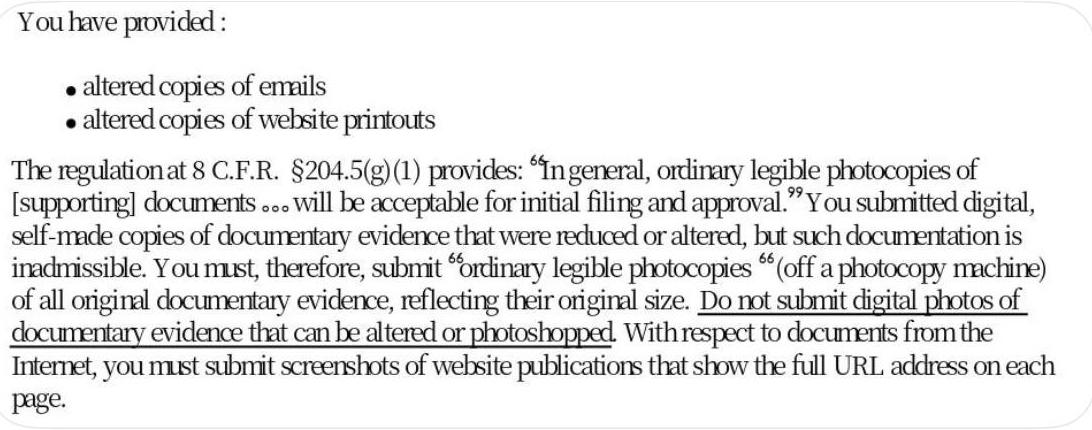
USCIS is accepting digital filings, but they are becoming much stricter about digital evidence integrity. That mismatch is what is driving RFEs like the one in your screenshot.
For many years, employment-based immigration petitions like EB-1A and NIW followed a predictable pattern. Applicants prepared thick paper binders. Attorneys mailed physical packets. USCIS officers reviewed printed documents.
That was the system.But now, everything is shifting. USCIS has moved toward online filing and digital submissions, and many applicants assumed that this meant:
“If it’s uploaded online, any PDF or screenshot should be fine.”
Unfortunately, a growing number of RFEs show that USCIS does not see it that way.
A new trend is emerging: USCIS is accepting digital petitions, but rejecting digital-looking evidence.
Let’s unpack what is happening.
A Real Example: RFE on Evidence Format
Recently, an EB-1A applicant received an RFE , not because their achievements were insufficient, but because of one issue:
USCIS questioned the authenticity and format of the submitted documents.
The officer wrote:
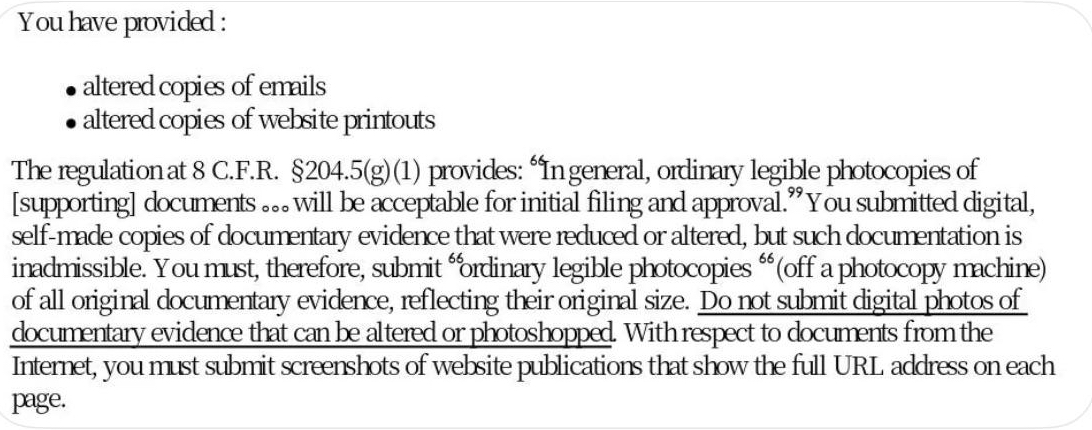
“You submitted digital, self-made copies of documentary evidence that were reduced or altered, but such documentation is inadmissible.”
And then came the key instruction:
“You must submit ordinary legible photocopies of an original documentary evidence…
Do not submit digital photos of documentary evidence that can be altered or photoshopped.”
This is not about whether the applicant qualifies. This is about whether USCIS trusts the evidence format.
That is a major shift.
The Core Issue: Digital Filing Does Not Mean Digital Evidence Is Treated Equally
Here is the confusion: USCIS encourages online filing. But USCIS officers still apply standards built for paper-era verification.
In the paper world:
Letters were printed on letterhead
Articles were physically clipped
Documents were photocopied
Evidence looked “real”
In the digital world:
Applicants embed JPEGs into PDFs
Screenshots are cropped
Web printouts lose URLs
Documents look editable
To an officer, that introduces doubt.
And doubt leads to an RFE.
Why USCIS Is Becoming More Strict Now
This trend is increasing for three reasons:
1. Digital Submissions Are Easier to Manipulate
A screenshot can be edited in seconds.
A JPEG inside a PDF can be altered.
Officers know this.
2. Fraud Detection Has Increased
USCIS has expanded its internal focus on document integrity and fraud prevention.
Even strong applicants can get flagged if evidence presentation looks “self-made.”
3. The System Transition Is Incomplete
USCIS is modernizing filing systems faster than adjudication standards.
So applicants are stuck in the middle: Digital intake, paper-era expectations.
What USCIS Officers Are Essentially Saying
If we translate the officer’s statement into plain English:
“We are not questioning your achievements yet.
We are questioning whether these documents are trustworthy in their current form.
Submit evidence in a format that looks unaltered, official, and verifiable.”
That is the new reality.
How Applicants Should Resubmit Evidence Correctly
Let’s answer the two big questions from the screenshot.
1. Recommendation Letters: PDF or Print-and-Scan?
Best practice:
Use the original PDF directly from the recommender
Ensure it is on letterhead, if not ensure it is original using certified digital signature (DocuSign, Adobe PDF)
Include signature
Avoid converting into images
If the letter only exists digitally:
Keep it as a clean PDF
Do not embed it as a JPEG inside another file
If USCIS wants “photocopies”:
Print the signed letter
Scan it as a normal PDF
Submit that scan
That makes it look like traditional documentary evidence.
2. Website Evidence: Screenshots or Printouts?
USCIS explicitly states:
“You must submit screenshots of website publications that show the full URL address on each page.”
So yes, screenshots are acceptable, but only if:
Full URL is visible
Date is visible if possible
The page looks complete, not cropped
Avoid:
Cropped snippets
Images without source context
Content pasted into Word documents
The goal is verifiability.
The Bigger Lesson: Presentation Is Now Part of the Petition
We were keen on credibility of evidence even EB-1A success was mostly about:
Meeting criteria
Strong evidence
Legal framing
Evidence authenticity and formatting.
Even a qualified applicant can face delays if USCIS feels the evidence is “editable.”
What This Means for the Future of EB-1A and NIW
This is a structural change.
USCIS is moving into a world where:
Digital petitions are normal
But digital evidence must still look official
Officers want documents that feel “court-admissible”
Applicants must adapt.
Merit Alone Is Not Enough Without Trustworthy Evidence
The strongest petitions are not just about achievements.
They are about credibility, clarity, and documentation integrity.
The new standard is:
“Show your merit, and show it in a form USCIS can trust.”
If you are filing online, treat your evidence like it will be printed, photocopied, and audited.
Because in many ways, it still is.
If You’re Building or Filing Right Now…
This is exactly why structured attorney-guided platforms matter.
Not to replace legal judgment, but to prevent avoidable RFEs caused by formatting, trust, and evidence presentation.
Digital filing is the future.
But documentary standards are still catching up.
This article is general information, not legal advice. Meritocrat is a preparation tool, not a law firm, and does not replace qualified legal counsel.
Prepare your case in one connected workspace
Case Studio helps EB-1A, EB-2 NIW, and O-1 applicants organize evidence and review what supports each claim.