Analysis
USCIS August 2026 Data: Employment Green Cards Are Moving Faster, and What It Means for the Visa Bulletin
USCIS's August 2026 report to Congress shows employment-based adjustment of status moving faster than any other green card line, with 9 in 10 decisions approved. What the numbers mean for Visa Bulletin movement, and what they don't tell you.
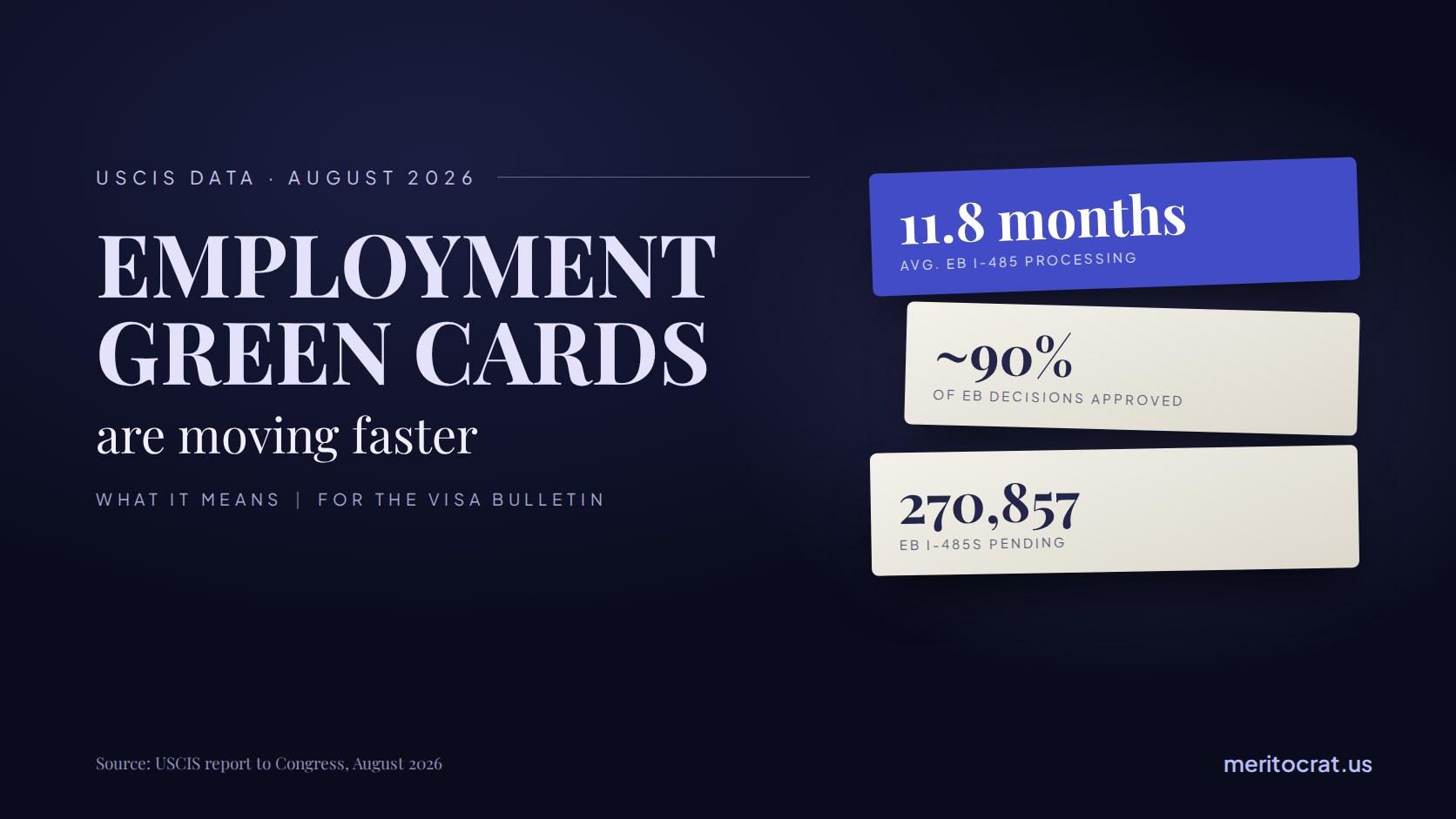
Every month, USCIS sends Congress a snapshot of its workload: how many applications came in, how many were approved or denied, how many are still waiting, and how long decisions took. The August 2026 report, queried in September 2026, is especially useful because it covers the last full month before a new fiscal year opens on October 1.
For employment-based green card applicants, the headline is encouraging. Adjustment of status for employment cases is moving faster than any other green card line, most decisions are approvals, and USCIS is using visa numbers at the pace the law allows. Here is what the data shows, how it connects to the Visa Bulletin, and where the caution flags are.
The employment-based numbers at a glance
| Employment-based I-485, August 2026 | Figure |
|---|---|
| New applications received | 13,797 |
| Approved | 11,694 |
| Denied | 1,323 |
| Share of decisions approved | About 90% |
| Pending at month end | 270,857 |
| Pending more than 6 months | 137,354 (51%) |
| Average processing time | 11.8 months |
Source: USCIS, Number of Service-Wide Forms by Month, Form Status, and Processing Time, August 2026. Percentages are our calculations from the reported figures.
Positive sign 1: The fastest green card line in the report
The report breaks adjustment of status (Form I-485) into six categories. Employment-based cases had the shortest average processing time of all of them.
| I-485 category | Avg. processing time | Pending | Pending over 6 months |
|---|---|---|---|
| Employment | 11.8 months | 270,857 | 51% |
| Family | 12.4 months | 601,751 | 75% |
| Refugee | 16.3 months | 157,877 | 80% |
| Cuban | 20.6 months | 355,520 | 97% |
| Other | 22.1 months | 77,774 | 73% |
| Asylum | 29.9 months | 138,562 | 79% |
Just as important is the age of the queue. Only about half of pending employment cases are more than six months old, compared with three quarters or more in every other category. The employment inventory is younger, which suggests cases are moving through rather than sitting.
Positive sign 2: Nine in ten decisions were approvals
Of the 13,017 employment-based I-485 decisions USCIS made in August, 11,694 were approvals. That is roughly 90%, the highest approval share of any I-485 category in the report. Family-based cases, by comparison, were about 81%.
For applicants, this matters because an approved I-485 is the moment a visa number is actually used. A high approval share means the numbers the Visa Bulletin makes available are turning into green cards.
Positive sign 3: Visa numbers are being used, not wasted
USCIS approved 11,694 employment-based green cards in August. At that pace, a full year would come to about 140,000, which matches the statutory minimum for employment-based immigrant visas each year.
This is the part that connects most directly to the Visa Bulletin. When USCIS approves cases quickly near the end of a fiscal year, the year's numbers get used. When it cannot, numbers can go unused and demand builds up for the following year. Strong processing is also part of why some categories, such as EB-2 India, used up their FY2026 numbers before the year ended. Those limits reset on October 1, when FY2027 begins.
Positive sign 4: Work permits are clearing faster than they arrive
Many adjustment applicants rely on a work permit (Form I-765) while their green card case is pending. In August, USCIS completed 155,224 work permit applications against 130,329 new ones, reducing that queue by roughly 25,000. The average processing time was 6.8 months.
This connects to the Dates for Filing chart. When USCIS allows applicants to file using that chart, they can usually apply for a work permit alongside their I-485. A work permit queue that is shrinking makes an early filing more useful. For how that chart works, read our guide to Dates for Filing vs. Final Action Dates.
How this feeds into the Visa Bulletin
The Visa Bulletin is set by the Department of State, but USCIS data is one of its main inputs. Each month the two agencies compare the visa numbers left in the fiscal year with the demand they can see. That demand includes adjustment applications pending at USCIS.
The August report points to three things for FY2027:
- Demand is visible and ready. 270,857 pending employment-based I-485s is a large, documented inventory. That gives the Department of State a clear picture of demand when it sets dates.
- USCIS can use numbers quickly. A processing pace in line with the annual limit means that when dates advance, approvals can follow. That supports steady use of the FY2027 allocation from the start of the year.
- A fresh start on October 1. Categories that ran short of numbers in FY2026 get a new annual allocation. Combined with fast processing, that is the setup for the forward movement many applicants are watching for in the October bulletin. For our India forecast, see the October 2026 Visa Bulletin prediction.
What to keep in perspective
The data is encouraging, but it has limits, and some numbers cut the other way.
- The queue is still large. Employment receipts (13,797) slightly outpaced decisions (13,017) in August, so the pending count grew by about 780 that month. At August's pace, clearing today's 270,857 pending cases would take roughly 21 months.
- A big pending inventory can hold dates back. The same visible demand that helps the Department of State plan can also lead it to advance dates cautiously, so that approvals stay within the annual limits.
- The report does not break down by category or country. It does not separate EB-1, EB-2, and EB-3, or show India and China separately, and it does not include I-140 petitions. Country-specific movement depends on per-country limits that this report cannot show.
- One month is a snapshot. August is often a heavy month as USCIS works to use numbers before the fiscal year ends. Trends over several months are more reliable than a single report.
- Family processing affects employment numbers too. Family-based I-485 decisions (31,162) outpaced receipts (29,085) in August. Under immigration law, unused family-based numbers from one year are added to the next year's employment-based limit. Strong family processing is good for family applicants, but it can mean fewer spillover numbers for employment categories.
What this means if you are preparing a petition
Faster adjustment processing helps at the end of the green card process. It does not change what comes first. For EB-1A and EB-2 National Interest Waiver self-petitioners, the I-140 petition and the evidence behind it still decide whether you reach the adjustment stage at all.
If your priority date is still some way off, this is a good time to strengthen your case. You can check which criteria your documents support, see what is still missing, and organize everything in Case Studio before you spend on legal counsel.
Sources
- USCIS: Immigration and Citizenship Data (Number of Service-Wide Forms by Month, Form Status, and Processing Time, August 2026; ELIS and CLAIMS3, queried September 2026)
- USCIS: Adjustment of Status Filing Charts from the Visa Bulletin
- Department of State: Visa Bulletin
This analysis is general information, not legal advice. USCIS notes that its figures reflect the data available when queried and may differ from other published reports. Meritocrat does not determine visa availability or replace legal counsel. Confirm the current Visa Bulletin and USCIS chart selection before filing.
Prepare your case in one connected workspace
Case Studio helps EB-1A, EB-2 NIW, and O-1 applicants organize evidence and review what supports each claim.