Analysis
EB-1A Approvals Are Collapsing: What Honest Applicants Can Do
The EB-1A approval rate fell from about 67% to about 32% in under a year. Why it happened, why Indian applicants still file it, and how to build a case that is true.
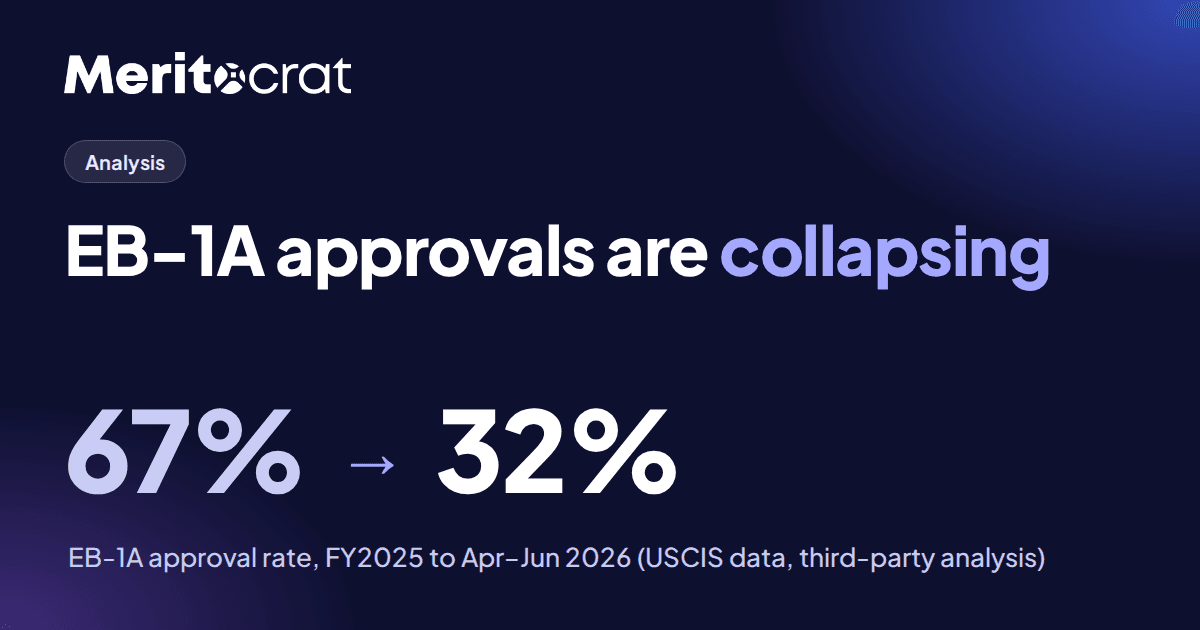
Fewer than one in three decided EB-1A petitions is now approved. A year earlier, it was about two in three.
One hundred cases, two different years
Take 100 EB-1A cases that USCIS decided across fiscal year 2025. Roughly 67 were approved. Now take 100 decided between April and June 2026. Roughly 32 were approved.
Same visa. Same law on paper. Same kind of person: a researcher, a founder, an engineer with a stack of exhibits and a lot of hope. Only the outcome moved.
For us this is not abstract. Before he built Meritocrat, Kumaresh read these rules for a deeply personal reason. He was trying to get his child through before the child aged out. He looked at EB-1C first, because it was the route that still said yes. Then he saw the catch. The route meant time working outside the country, and his child was not supposed to stay out of it.
So this article is about three things. What happened to EB-1A. Why the line behind the approval is so unequal. And what an honest person does about it.
What is actually being wiped out
The EB-1A approval rate fell from about 67% in fiscal 2025 to about 32% in the April to June 2026 quarter.
| Period | EB-1A approval rate |
|---|---|
| FY2025 (full year) | ~66.9% |
| FY2026 Q1 (Oct to Dec 2025) | ~47.5% |
| FY2026 Q2 (Jan to Mar 2026) | ~41.7% |
| FY2026 Q3 (Apr to Jun 2026) | ~32.0% |
The rate here means approvals divided by approvals plus denials in that quarter. Pending cases are not counted. By Q1, USCIS had already denied more petitions than it approved: 2,414 denials against 2,180 approvals. By Q3, a third-party analysis of USCIS's quarterly report says denials outpaced approvals more than two to one.
Why? Three reasons keep coming up:
- Officers lean on the final merits step, the second half of the test. Meeting the criteria on paper is no longer enough.
- Many people filed EB-1A as a bypass around long green card queues. That raised suspicion.
- Evidence that looks manufactured now gets little weight. Think pay-to-play media, informal judging, nominal memberships and generic reference letters.
One court has already pushed back. A federal district court found the final merits determination was unlawfully adopted and arbitrarily applied in one EB-1A case and ordered the petition approved. That is one case, not a trend. Still, it shows the standard is contested.
A caution on the numbers. They come from law-firm and consultant write-ups of USCIS data, not from USCIS directly. Check them against the USCIS quarterly I-140 report before you quote them anywhere that matters.
Why EB-1A became a big deal after 2020
EB-1A became the door people tried when every other door had a queue behind it.
It needs no employer and no job offer. You can petition for yourself. For someone stuck in a long green card line, that sounded like a way out.
The filing numbers show the rush. One law-firm summary of USCIS data says EB-1A petitions now run above roughly 7,500 a quarter, nearly triple the level four years earlier. It ties the growth to three pressures: frustration with the H-1B program, long green card backlogs for professionals from India and China, and the appeal of a route without a sponsor.
Think about what that looks like from the officer's chair. Year after year, more files arrive claiming extraordinary ability. Many are strong. Some are stretched. An officer cannot tell the two apart at a glance, so the bar goes up for everyone.
That is the quiet cost of a popular visa. When a route turns into a bypass, the people who truly belong on it pay for the people who don't.
Why Indians reach for EB-1A, not EB-2 NIW
Indian applicants choose EB-1A because its line is under four years long, while the EB-2 line behind it is nearly thirteen.
These are the cut-off dates in the October 2026 Visa Bulletin (final action dates). A petition is only served once its priority date is earlier than the cut-off.
| Category | India | China | Rest of world |
|---|---|---|---|
| EB-1 | Feb 1, 2023 | Jul 1, 2023 | Current |
| EB-2 (where NIW sits) | Nov 1, 2013 | Oct 1, 2021 | Jan 1, 2025 |
Read the India column. In EB-2, people are still being served whose petitions date from 2013. In EB-1, the cut-off is early 2023. Same country, same person, same talent. Only the box on the form changes, and with it roughly nine years of waiting.
For the month-by-month detail, see our October 2026 Visa Bulletin analysis. USCIS can also choose which chart applicants must use to file, so read Dates for Filing vs. Final Action Dates before you act.
The rule behind the wall
The reason is a rule. Under federal law, no single country may receive more than 7% of the green cards in a preference category in a year. A 2021 estimate in that same article put more than 700,000 Indians in line behind approved EB-2 and EB-3 petitions, for about 8,000 visas a year.
A rule built to keep the pool diverse becomes a wall when demand from one country is this large.
Where the unfairness really sits
Let us be precise here, because this is where the conversation usually goes wrong. The unfairness is not in the test.
The NIW test is the same for everyone. The work must have substantial merit and national importance. The person must be well positioned to advance it. And waiving the job offer must benefit the country. An officer reading a petition from Lahore applies the same standard as one reading a petition from Hyderabad.
It is not easy for anyone, either. The NIW approval rate fell from about 55% in fiscal 2025 to about 43% in the first quarter of fiscal 2026.
The unfairness sits in the line. Someone born in a country without a backlog can watch an approved NIW turn into a green card quickly. That door has narrowed too. Worldwide EB-2 was current in September 2026 and retrogressed to January 1, 2025 in October. But for now, the person from India with the same approved file is still waiting behind a 2013 date.
That is where equality breaks. Merit is measured the same everywhere, but the reward arrives on a different calendar depending on where you were born. Nobody is lowering a bar for anyone. The wait is simply not shared equally.
So Indian applicants do the rational thing. They go where the line is shortest, even though it asks for the most proof. A person with a strong NIW-quality case ends up trying to prove extraordinary ability. A four-year line is survivable. A thirteen-year line is a different life. In those years a job cannot easily be changed, a company cannot easily be started, and a child can turn 21 while a parent waits.
And then the squeeze closes. The category with the shortest line is also the one whose approval rate fell to about 32%.
In our view, a fair system does not take green cards away from anyone. It measures merit the same for everyone, and it does not turn a birth certificate into a decade of waiting. Whether a 7% rule still serves that goal is a public question. It deserves far more discussion than it gets.
EB-1C is not surging. It is steady, and it is narrow.
EB-1C approvals sit near 97%, and filings are not climbing. This is a steady route, not a stampede.
| Quarter | Filed | Approved | Denied | Approval rate |
|---|---|---|---|---|
| FY2025 Q1 | 4,601 | 2,881 | 89 | 97% |
| FY2025 Q3 | 3,731 | 2,634 | 64 | 97.6% |
These figures come from a third-party summary of USCIS data and cover fiscal 2025, not 2026. Check newer EB-1C data before anyone quotes a trend.
So why does it come up every time EB-1A news turns bad? Because it is the visa that still says yes. But the reason it says yes is the reason it is hard to use. EB-1C has no self-petition option. A company has to file for you, and four things must hold:
- You worked at least one year outside the United States for a qualifying related company, within the three years before filing (or before you entered the U.S.).
- The U.S. employer is the same company as, or a parent, subsidiary, or affiliate of, that foreign company.
- The U.S. employer has been doing business for at least a year.
- The U.S. job is managerial or executive in its actual duties, not just in its title.
It is a visa for people who already sit inside a real multinational structure. It is not a shortcut for someone who is building one.
A father's dilemma: the safe visa asks the family to split
For a parent racing a child's birthday, the safest visa on paper can be the riskiest in practice.
Kumaresh looked at EB-1C before he ever looked at EB-1A. He was not a founder then. He was a parent whose child was close to aging out, and EB-1C's high approval rate made it look like the safe bet. But the rules carry a condition the approval rate hides. The qualifying year has to be spent working abroad for a related company. Time worked in the United States does not count, whoever pays the salary.
So the honest question was never whether EB-1C works. It was what staying outside the country would cost. For a family in that position, it could mean the child's school, friends and daily life here. Those are the very things the green card is meant to protect. Trading that for a better approval rate is a trade few parents can make with a clear head.
There is a second layer, and it needs a lawyer, not a blog. EB-1C has no self-petition option, and the job has to be managerial or executive in its actual duties. Whether a given person fits, and how the age rules treat a child's birthday, depends on the dates and paperwork in that one file.
This is the road that led Kumaresh toward EB-1A. Not because it was easy. It was already getting harder. But it was the route that did not ask his family to be anywhere other than where they already were.
Kumaresh did get his green card approved. His first child was almost ready for college when it came. For families like his, the calendar is part of the case.
Why we do not bend the system
When the odds fall this fast, the pull to bend the truth gets stronger. That is exactly when it is most dangerous.
We understand the pull. When a coin lands tails two times in three, people start to think they should dress the coin. They stretch a job title. They call a small circle of friends an association. They collect letters that say everything and prove nothing.
We have watched people who know this system well feel that same pull. That tells you how heavy the pressure is.
Here is why it does not pay:
- The things people fake are the things officers now look for first. Pay-to-play media, informal judging and nominal memberships already carry little weight.
- A weak true case can be strengthened with time. A false one cannot be fixed, only withdrawn.
- A finding that you willfully misrepresented a material fact can follow you far beyond one petition. Ask an immigration attorney what that means for any future filing.
So we believe in the process, with its flaws. Not because it is fair, but because it is the only path that is still there after the paperwork ends. You do not have to lie to the system. You have to be clear about what you have actually done, and patient enough to show it.
How to show who you are, truthfully
A truthful case is built from what other people can check, not from what you can claim.
This is the hard part of the world we live in. You must project yourself, because no one else will. But projecting is not inflating. Projecting means choosing which true things to put in front of a stranger who has twenty minutes.
Some habits that hold up:
- Say your role exactly. If you founded a company, show what you decided, built and shipped. If your title is bigger than your duties, trust the duties.
- Prefer evidence others made without being asked. Press that found you, a judge who invited you, a customer who wrote about your work. Independent proof outweighs anything you produce about yourself.
- Make your letters specific. A letter from someone who saw your work, naming what you did and what changed because of it, beats a famous name saying you are great.
- Claim narrowly and prove it deeply. Pick the few criteria you truly meet and make each one undeniable, rather than touching all ten.
- If the honest case is thin, give it time. Another year of real work can do more than another binder of weak exhibits.
None of this guarantees an approval. Nothing does, and at a 32% rate nobody should promise you one. What it gives you is a file you can stand behind, in front of an officer today and in front of anyone who reads it later.
Where this leaves us
EB-1A is not dead, but the era of filing on thin evidence and hoping is over.
If you are weighing EB-1A, EB-1C or another route, start with an honest inventory. List what you have done, who can verify it, and where you actually live and work. Then take that inventory to a qualified immigration attorney.
Kumaresh did get his approval. The process is slow, the odds are worse than they were, and the only plan that does not collapse is the one built on what is true.
This article is general information, not legal advice. Meritocrat is a preparation tool, not a law firm, and does not replace qualified counsel.
Sources
- USCIS Q3 FY2026 data: EB-1A approval rates (third-party analysis)
- FY 2026 approval rates for EB-1A and EB-2 NIW
- EB-1A filings surge as H-1B pressure intensifies
- EB-1C visa statistics
- L-1A to EB-1C: requirements, timing and the one-year rule
- Decades-long waits for green card if you were born in the "wrong" country
- October 2026 Visa Bulletin Released (Erickson Immigration Group)
- October 2026 Visa Bulletin Released (Manifest Law)
- October 2026 Visa Bulletin reopens India EB-2
All figures are as of October 10, 2026, from secondary sources that cite USCIS. Check USCIS's quarterly I-140 reports and the official Visa Bulletin for current data.
Prepare your case in one connected workspace
Case Studio helps EB-1A, EB-2 NIW, and O-1 applicants organize evidence and review what supports each claim.