Analysis
OPT Fee Proposal and the H-4 EAD: What Is Proposed, and What It Means Today
DHS has proposed a school-paid fee for OPT and listed H-4 EAD rescission on its agenda. Here is what each one says, what has not changed, and practical steps to take now.
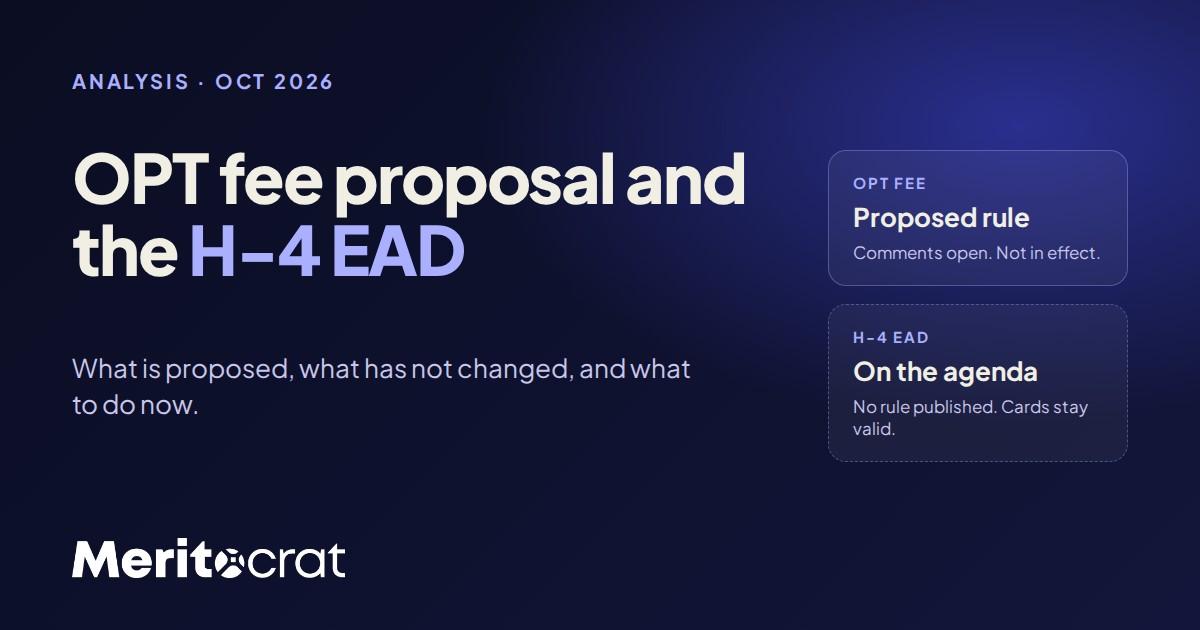
Two immigration headlines this week are easy to confuse, so here they are separately. One is a published proposal with a comment period. The other is an early-stage item on a government agenda. Neither has changed anyone's status today.
The OPT fee proposal
On October 8, 2026, DHS published a proposed rule in the Federal Register that would add a fee for Optional Practical Training.
- $70,000 for a student's first OPT, of any type.
- $30,000 for each later OPT, including the STEM extension.
- The school pays, not the student. A designated school official could not enter an OPT recommendation in SEVIS until the school has paid.
The text we reviewed did not propose exemptions for small schools, and refunds would be limited. Comment deadlines appear as November 9, 2026 in one place and December 7, 2026 in another, so confirm the date in the official notice. If a final rule is published, the proposal says it would take effect 60 days later.
What this could mean
A proposal is not a rule. It can be revised after public comment, delayed, or challenged. If something like it were finalized, some schools might hesitate to offer OPT support or pass the cost on to students, which could affect people who plan on OPT before H-1B. We cannot tell you that will happen. Plans that depend on OPT are worth reviewing, not abandoning.
The H-4 EAD
DHS has listed ending the H-4 work permit for H-1B spouses on its regulatory agenda as a "Long-Term Action." That means a plan to consider a rule. No proposed rule text has been published.
- Current H-4 EADs remain valid until the expiration date on the card.
- A new rule would need to be published, open for public comment, and finalized before it applied to anyone.
- An earlier attempt to do this was sent for review in 2019 and withdrawn in 2021 without being published.
Practical steps now
- Check your card's expiration date and file renewals early. Renewals filed on or after October 30, 2025 do not receive automatic extensions.
- Use current form editions. USCIS says older editions of Forms I-539 and I-765 are rejected for filings made on or after September 15, 2026.
- Plan for long processing times. Reported waits for H-4 work permits run roughly 6 to 15 months, and premium processing is not available.
- Watch the official notices. Publication in the Federal Register is the signal that something has actually changed.
Get clarity on your situation
Your timeline, your employer, and your current status all change what makes sense for you. You can book a consultation with an Expert Advisor at app.meritocrat.us. Consultations are advisory and are not legal advice. Meritocrat is not a law firm. For a specific filing, speak with a licensed immigration attorney.
Sources: Optional Practical Training Fees, Federal Register; DHS announcement; Reddy Neumann Brown on the H-4 EAD agenda entry; VisaVerge on H-4 EAD status.
Prepare your case in one connected workspace
Case Studio helps EB-1A, EB-2 NIW, and O-1 applicants organize evidence and review what supports each claim.